

Online Quran Classes for Teenagers: Is It Too Late to Start?
Online Quran Classes for Teenagers can give young learners a flexible way to improve Quran reading, develop Tajweed skills, memorize selected portions, and build a consistent relationship with the Quran. However, teenagers need a learning experience that recognizes their age, school responsibilities, interests, confidence, and growing independence.
Unlike younger children, teenagers may already have years of Quran learning behind them. Some can read fluently but need better Tajweed, while others may have memorized portions of the Quran but struggle to maintain regular revision. Meanwhile, some teens may be returning to Quran study after a long break and need to rebuild their confidence gradually.
For that reason, choosing Quran lessons should begin with the teenager’s actual level rather than age alone. The right program should provide clear objectives, meaningful practice, respectful communication, and a schedule that can work alongside school and other responsibilities.
Quran Kids Academy can provide an online learning environment for families looking for structured Quran education for younger learners and teenagers. More importantly, parents should understand what makes a Quran program suitable for a teenager before choosing a long-term learning plan.
Why Online Quran Classes for Teenagers Need a Different Approach?

Teenagers are at a stage where they want greater independence while still benefiting from guidance. Consequently, a Quran lesson that feels too childish may reduce engagement, even when the teaching material itself is appropriate.
A teenager also becomes more conscious of mistakes and feedback. Therefore, correction should be direct but respectful. The goal is not to avoid correcting errors. Instead, the teacher should explain the mistake clearly and give the student an opportunity to correct it independently. A useful teenage Quran lesson should balance several elements:
- Accurate Quran reading and pronunciation
- Age-appropriate communication
- Clear learning objectives
- Regular opportunities to recite
- Constructive correction
- A manageable schedule
- Gradual development of independence
- Appropriate review between lessons
The learning goal matters just as much as the teaching style. One teenager may want to improve fluency, another may want to focus on Tajweed, while a third may be interested in memorization.
As a result, Online Quran Classes for Teenagers should not follow one identical path for every learner. The starting point needs to reflect what the student already knows and what they want to accomplish next.
Start Learning Tafsir Classes Online Today
If you want to understand the Quran deeply with clear explanations and guided learning, now is the right time to begin your journey. Tafsir Classes Online at Quran Kids Academy provide structured lessons that simplify Quran meanings while helping students apply Islamic teachings in daily life.
In addition, experienced teachers support learners step by step to improve understanding, build confidence, and strengthen spiritual connection with the Quran. Users can also explore more related options.
Therefore, joining today can help you or your children gain authentic knowledge in a flexible and comfortable learning environment. Take the first step now and start building a stronger relationship with the Quran through guided tafsir education.

How to Choose Online Quran Classes for Teenagers?
Before enrolling a teenager, parents should look beyond the words “online Quran classes.” Different programs can vary considerably in teaching methods, lesson structure, teacher communication, scheduling, and expectations for independent practice.
Start by identifying the teenager’s current situation. Ask whether the student can read the Quran independently, whether pronunciation problems occur frequently, whether previous memorization has been maintained, and what the learner hopes to achieve. A practical evaluation can include:
- Current Quran reading level: Can the teenager read connected Arabic words comfortably?
- Tajweed knowledge: Does the learner understand and apply basic Tajweed rules?
- Memorization experience: Has the student memorized before, and how well is that material retained?
- Learning objective: Is the main goal reading, Tajweed, Hifz, revision, or a combination?
- Available time: How much time can the student realistically dedicate each week?
- Learning preferences: Does the teenager respond better to direct correction, repetition, explanation, or independent practice?
This initial assessment prevents an important problem: placing a student in lessons that are either too easy or unnecessarily difficult.
For example, a fluent reader may become bored if every lesson focuses on basic letter recognition. On the other hand, a student who still struggles with connected words may need more reading practice before beginning an intensive memorization plan.
What Should Teenagers Learn First?
Age alone should not determine the first subject. Instead, the teacher should listen to the student’s recitation and identify the skill that currently limits progress. Consider these common situations:
| Current situation | Suitable focus | Main objective |
|---|---|---|
| Reads Arabic slowly | Reading fluency and pronunciation | Improve confident word recognition |
| Reads independently but repeats mistakes | Applied Tajweed | Improve accuracy during recitation |
| Reads comfortably and wants Hifz | Memorization and revision | Build new memorization while protecting older portions |
| Previously memorized but became inconsistent | Revision and recovery | Restore regular recall |
| Understands basic rules but rarely applies them | Guided recitation | Transfer Tajweed knowledge into actual reading |
A teenager who reads slowly does not necessarily need lengthy theoretical Tajweed lessons. Similarly, someone who already reads confidently should not spend months repeating skills they have mastered.
Instead, the program should identify one primary objective and use supporting activities around it.
For example, a learner working on Tajweed may spend most of the lesson reciting while the teacher identifies specific pronunciation or rule-related issues. A student focusing on Hifz may divide the session between new memorization and revision.
The Quran also emphasizes measured recitation. Therefore, progress should not be judged solely by how many pages a student completes. Accuracy, control, pronunciation, and consistency are equally important parts of meaningful Quran learning.
Quran Reading, Tajweed, and Hifz for Teenagers
Online Quran Classes for Teenagers can support several learning paths, but the appropriate path depends on the learner’s needs.
Quran Reading
Reading fluency is the foundation for students who still hesitate when connecting Arabic letters and words. In this stage, the teacher can focus on pronunciation, word recognition, stopping points, and smoother recitation.
The objective is not simply to make the student read faster. Rather, the teenager should gradually become more confident and accurate.
Tajweed
Students who already read comfortably may need to improve how they apply Tajweed rules during actual recitation. This requires practice, because knowing a rule theoretically does not always mean applying it correctly.
Therefore, lessons should combine explanation with repeated reading. After receiving correction, the student should recite the same passage again and attempt to apply the feedback.
Hifz
Memorization requires a different type of organization. New verses should not completely replace revision of previously memorized material.
A balanced Hifz routine can include:
- Reviewing older memorization
- Revising recently memorized passages
- Introducing a manageable amount of new material
- Listening carefully to the student’s recitation
- Identifying weak sections
- Repeating difficult passages
- Maintaining a realistic home practice routine
For teenagers with school commitments, the amount of new memorization should be realistic. A smaller amount that remains consistent can be more practical than an ambitious schedule that becomes difficult to maintain.
How to Choose a Teacher for Online Quran Classes for Teenagers?
Teacher qualifications matter, but communication is equally important when teaching teenagers. A student should be able to make a mistake, receive correction, and try again without feeling embarrassed. During the selection process, parents can look for several characteristics.
The Teacher Listens First
A teacher should hear the student’s recitation before deciding exactly where the lessons should begin. This creates a more individualized learning plan.
Corrections Are Clear
Good feedback should tell the learner what went wrong and how to improve it. Excessive technical explanation can sometimes make a simple correction harder to understand.
The Student Participates
Teenagers should not spend most of a Quran lesson listening to the teacher. They need sufficient time to read, repeat, practice, and demonstrate what they have learned.
Communication Is Respectful
The teacher should be encouraging without speaking to the teenager as though they were a very young child. At the same time, the learner should understand that correction is part of learning rather than a personal criticism.
Responsibility Gradually Increases
As the teenager improves, they can take more responsibility for remembering assignments, preparing passages, and identifying areas where they need additional practice.
Quran Kids Academy can be considered by parents who want an online Quran learning option, but families should still evaluate the teacher-student relationship, lesson structure, learning goals, and schedule before choosing a long-term arrangement.
What Makes a Good Teen Quran Lesson?
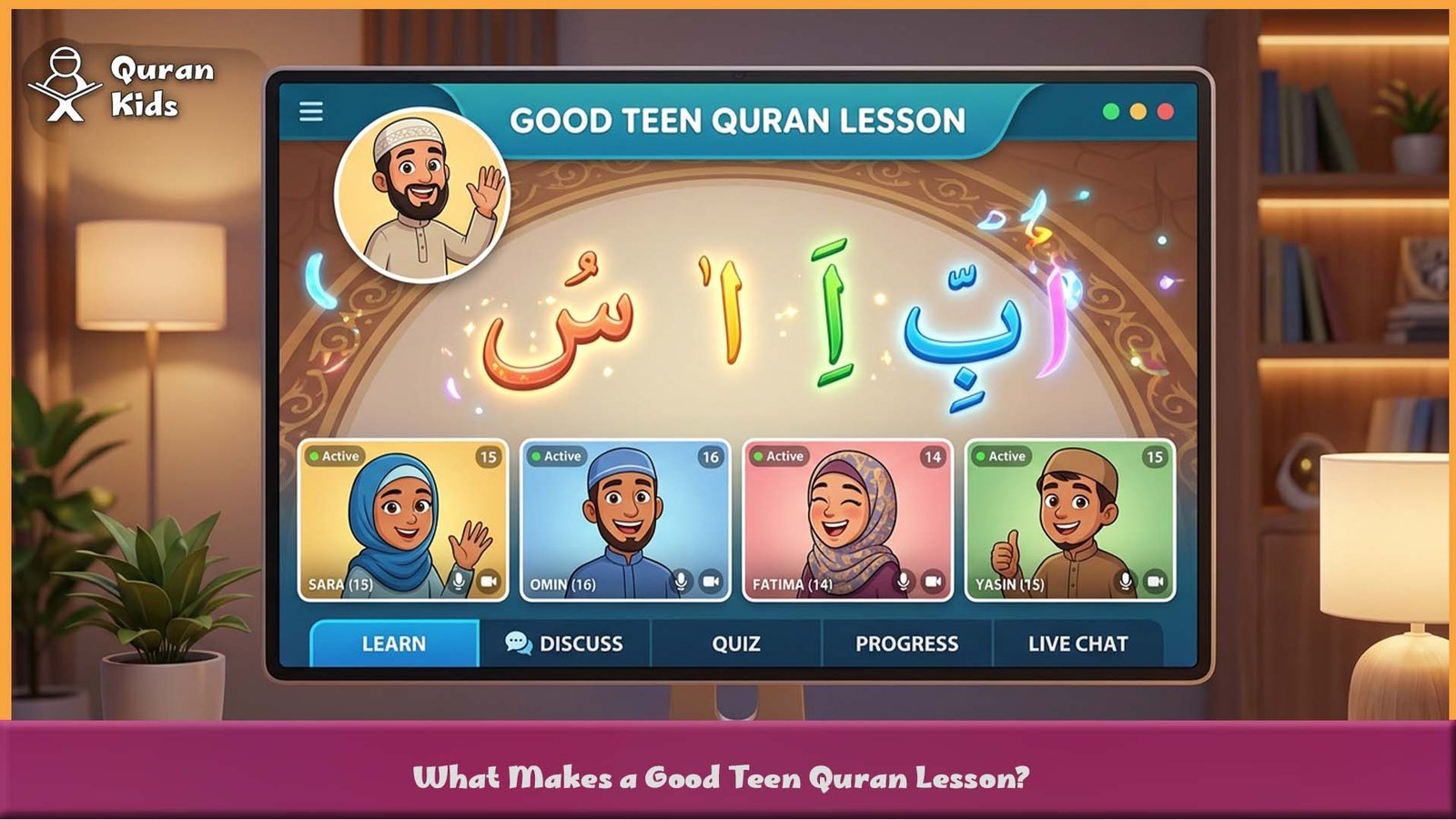
A productive lesson should have a clear purpose from beginning to end. The student should know what skill is being practiced and have enough time to use it. A typical session might include:
- A short review of previous work
- Recitation by the student
- Identification of important errors
- Explanation of the correction
- Repeated practice
- New material when appropriate
- A clear task for the next session
This structure keeps the lesson active. Instead of turning the class into a lecture, the teacher uses explanation only when it helps the teenager improve actual Quran reading.
Furthermore, the amount of correction should remain manageable. If a student receives too many corrections at once, remembering all of them can become difficult.
A better approach is to identify the most important issues, practice them, and return to other errors gradually.
How Long Should Online Quran Classes for Teenagers Be?
There is no universal lesson length that works for every teenager. A 30-minute session can be useful for focused practice, while a longer lesson may provide additional time for recitation, explanation, memorization, and revision. The decision should depend on the student’s attention, objective, weekly schedule, and ability to remain actively involved.
| Situation | Possible approach | What to avoid |
|---|---|---|
| Busy school schedule | Shorter focused lessons | Trying to cover too many objectives |
| Tajweed practice | Enough time for repeated recitation | Spending most of the lesson on theory |
| Hifz program | Separate new memorization and revision | Ignoring previously memorized portions |
| Examination period | Temporarily adjust workload | Abandoning the routine completely |
| Returning learner | Gradual sessions | Starting with an unrealistic workload |
Consistency is particularly important. A lesson schedule that looks impressive on paper but regularly conflicts with school, homework, activities, or sleep is unlikely to remain comfortable for the student.
Therefore, scheduling should be treated as part of the learning plan rather than an administrative detail.
How to Build a Quran Schedule Around School?
Teenagers often have demanding academic schedules. School assignments, examinations, sports, family responsibilities, and social activities can compete for the same hours. For that reason, Quran study should have a realistic place in the weekly routine.
Parents can begin by identifying the teenager’s most reliable periods of free time. A student may concentrate better after school on some days, while another may prefer an earlier or later session.
The schedule should also leave room for independent practice. A teenager does not necessarily need long daily sessions. Short, focused practice can help maintain continuity without creating excessive pressure. A practical weekly routine might include:
- Scheduled teacher-led lessons
- Short reading practice between classes
- Regular revision of memorized material
- One lighter day during demanding school periods
- Additional review before a new memorization target
When examinations approach, the schedule may need temporary adjustment. Reducing the workload for a short period does not mean abandoning Quran learning. Instead, it can help the teenager maintain the habit until the academic pressure decreases.
How to Track Progress in Online Quran Classes for Teenagers?
Teenagers need guidance, but they also benefit from knowing what they are working toward. Parents therefore need enough information to understand progress without turning every lesson into an interrogation. A simple progress system can focus on three questions.
What Is the Current Priority?
The main objective might be reading fluency, pronunciation, Tajweed, Hifz, or revision.
What Difficulty Keeps Returning?
Repeated errors can reveal where additional practice is needed. For example, a student may understand a Tajweed rule but consistently forget to apply it during fast recitation.
What Is the Next Milestone?
The next goal should be specific enough for the learner to understand. It might involve reading a particular passage more accurately, completing a revision target, or applying a specific Tajweed rule consistently. This approach gives parents visibility without reducing Quran learning to a simple numerical score.
More importantly, teenagers can gradually learn to monitor their own progress. That sense of responsibility can make the learning process more meaningful as they become older.
What Should Happen During a Quran Trial Lesson?
A trial lesson should provide genuine learning interaction rather than becoming mainly a sales presentation. The teenager should have an opportunity to read. The teacher can then identify the student’s current level and demonstrate how corrections will be handled. A useful trial can include:
- A reading sample: The teacher listens to natural Quran recitation.
- Initial assessment: Important strengths and weaknesses are identified.
- Practical correction: The student receives useful feedback.
- Repeat practice: The teenager applies the correction.
- Goal discussion: The learning objective is clarified.
- Schedule discussion: The family considers a realistic lesson routine.
After the session, parents can ask the teenager specific questions instead of simply asking whether they liked the teacher. For example:
- What did you learn today?
- Did the correction make sense?
- Did you have enough time to read?
- Which part felt difficult?
- Would you feel comfortable asking this teacher questions?
How can Parents Support Quran Learning Without Pressure?
Parental support remains valuable during the teenage years. However, the type of support may need to change. Younger children often need direct reminders and supervision. Teenagers may respond better when parents provide structure while allowing them to take greater responsibility.
Instead of asking after every class whether the student completed everything perfectly, parents can discuss the broader learning goal. For example, ask about the passage being studied or what the teenager found challenging. Encourage the learner to describe progress in their own words.
Parents can also help by protecting the scheduled lesson time. A quiet environment, stable internet connection, and suitable study space can make online learning easier.
At the same time, avoid turning every missed practice session into a major confrontation. If consistency declines, first consider whether the schedule, workload, difficulty level, or lesson structure needs adjustment. A supportive home environment can help the teenager view Quran learning as a meaningful part of life rather than another school assignment.
Common Mistakes When Choosing Quran Classes for Teenagers
Choosing a program simply because it uses the word “kids” can be misleading. Teenagers have different communication needs and may prefer more independence than younger learners. Before making a decision, parents may also want to understand the cost of online Quran classes for kids to set realistic expectations about online learning.
Another common mistake is selecting a program based entirely on lesson duration. More minutes do not automatically mean better learning. The quality of active practice matters more than simply extending the clock.
Some families also begin intensive Hifz before establishing stable reading habits. If the teenager still struggles with pronunciation or basic recitation, additional memorisation may make those difficulties harder to address. Comparing Quran Kids Academy with other online Quran academies can also help parents focus on teaching structure rather than relying on general claims.
Furthermore, parents sometimes expect rapid progress because lessons are online and convenient. Online learning removes travel time, but improvement still requires practice and consistency.
Finally, a temporary decline in motivation should not automatically be treated as laziness. The student may be experiencing examination pressure, an unsuitable schedule, repetitive lessons, excessive difficulty, or a lack of clear goals. Parents who are researching whether Quran Kids Academy is legit can use the same approach by looking for clear information about the learning experience.
How Quran Kids Academy Can Support Teen Quran Learning?

Quran Kids Academy can be part of a family’s search for structured online Quran education for children and teenagers. However, parents should begin by identifying what their teenager actually needs from the learning experience. A free trial online Quran class for kids can also give families a practical opportunity to understand how an online lesson works before establishing a routine.
For one student, the priority may be improving Quran reading. Another may need stronger Tajweed application, while a learner with previous memorization may require a structured revision routine.
A useful program should therefore connect the student’s current level with an achievable next step. When considering Quran Kids Academy, families can focus on practical questions such as:
- What learning goal should the teenager begin with?
- How is the student’s current Quran level identified?
- How much time does the learner spend actively reciting?
- How are mistakes explained and corrected?
- How is progress communicated?
- Can the schedule work alongside school?
- Does the teaching approach encourage gradual independence?
These questions help parents evaluate whether the learning structure matches their teenager rather than choosing based on a single feature. Understanding the refund and cancellation policy for online Quran classes may also be useful before making a long-term enrollment decision.
For teenagers, the relationship between teacher, student, and learning goal can have a significant effect on consistency. Therefore, the right starting point is more important than simply choosing the longest or most intensive course.
How to Help Teenagers Stay Consistent With Quran Learning?
Consistency becomes easier when the routine is realistic. A teenager who has school, homework, activities, and family responsibilities may struggle with an overly demanding Quran schedule. Start with a manageable target. Once the routine becomes familiar, additional practice can be introduced when appropriate. Several simple habits can help:
- Keep lesson times predictable.
- Prepare the Quran passage before the session.
- Review recently learned material regularly.
- Practice difficult verses in short sessions.
- Avoid postponing every revision task until the day before class.
- Keep a simple record of current goals.
- Adjust the workload during examination periods.
- Give the teenager increasing responsibility for preparation.
Motivation can also improve when the learner understands why a particular activity matters. Instead of simply saying, “You need to practice,” explain how the practice connects to smoother recitation, stronger memorization, or better application of Tajweed.
Over time, the teenager can move from relying entirely on parental reminders toward managing parts of the learning routine independently.
What Should Parents Ask Before Enrolling in Online Quran Classes for Teenagers?
Before choosing Online Quran Classes for Teenagers, parents can use a short checklist to compare programs more carefully.
Learning in Online Quran Classes for Teenagers
- What level will the student start from?
- Is the curriculum adjusted to the learner?
- Are reading, Tajweed, and Hifz treated as separate or connected goals?
Teaching in Online Quran Classes for Teenagers
- Does the student receive enough time to recite?
- How are mistakes corrected?
- Is the teacher’s communication appropriate for teenagers?
Scheduling Online Quran Classes for Teenagers Around School
- Can lesson times fit around school?
- Is the expected practice workload realistic?
- Can the routine be adjusted during examinations?
Tracking Progress in Online Quran Classes for Teenagers
- How will parents know what the teenager is improving?
- Does the student understand their own learning goals?
- How often should the learning plan be reviewed?
Student Experience in Online Quran Classes for Teenagers
- Does the teenager feel comfortable asking questions?
- Is the lesson challenging without becoming overwhelming?
- Does the student have an increasing role in managing their own progress?
These questions shift the focus from promotional language to the actual learning experience. Instead of choosing a program based only on general claims, parents can examine how the lessons are structured, how the teacher interacts with the teenager, and whether the learning plan can support steady progress.
Why do Individualised Learning Matters for Teenagers?
Teenagers can have very different Quran backgrounds even when they are the same age. One learner may have studied consistently for years, while another may be returning after a long break. Consequently, identical lessons can produce very different results.
An individualized approach allows the teacher to spend more time where the learner needs it. A student with strong reading skills may focus on Tajweed application, while another may need additional work on pronunciation and fluency.
The learning plan can also change over time. Once a teenager becomes comfortable with one skill, the teacher can introduce a new objective rather than continuing to repeat mastered material.
That flexibility is one reason families should evaluate the structure of Online Quran Classes for Teenagers rather than looking only at the number of lessons offered.
Creating a Positive Online Quran Learning Environment
The physical environment can influence the quality of an online lesson. Teenagers should ideally have a quiet location where they can hear the teacher clearly and recite without unnecessary interruptions.
A stable internet connection is also important because frequent technical interruptions can break concentration. Before the lesson, the student can prepare:
- Quran or suitable digital Quran resource
- Notebook for important corrections
- Headphones when appropriate
- Stable internet connection
- Quiet study area
- Previously assigned passage
Small preparations can save lesson time and help the teenager enter the session with a clear focus. Additionally, parents can avoid unnecessary interruptions during the class. Giving the teenager appropriate privacy and concentration can encourage greater participation.
Building Long-Term Quran Goals for Teenagers
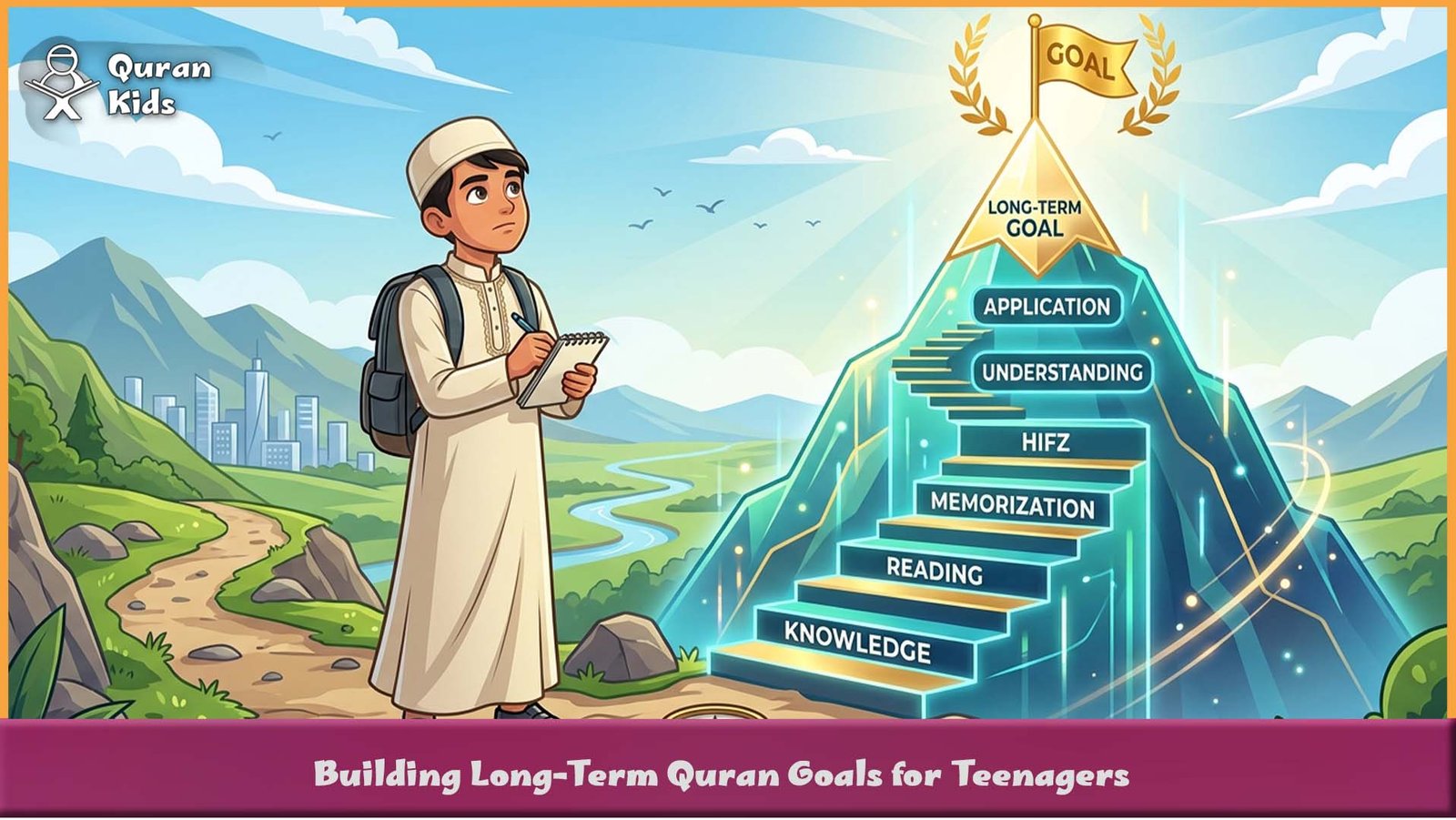
Quran learning does not need to be treated as a short-term project. A teenager can move through different goals as their skills develop. For example, the early stage might focus on reading accuracy.
Later, the student could concentrate more heavily on Tajweed. Once recitation becomes stable, memorization or deeper revision may become a stronger priority. A long-term plan can therefore develop through stages:
- Assess the current reading level.
- Strengthen essential weaknesses.
- Establish consistent practice.
- Develop Tajweed application.
- Introduce or organize memorization when appropriate.
- Maintain regular revision.
- Increase student responsibility over time.
This progression avoids the assumption that every teenager should immediately pursue the same objective. Quran Kids Academy can be considered within this broader approach when families are looking for an online Quran learning option. The important point is to match the program with the student’s current ability, available time, and personal learning objective.
Frequently Asked Questions about Online Quran Classes for Teenagers
can help parents understand the learning process, scheduling options, and ways to support their teenager’s Quran education.
Can teenagers join Quran classes if they have stopped learning for several years?
Yes. A teenager who has taken a long break does not necessarily need to restart from the beginning. The teacher can first assess current reading ability and then identify which skills need rebuilding.
Can a teenager study Quran online from a smartphone?
In many cases, a smartphone can support online learning, although the exact experience depends on the platform and lesson setup. A larger screen, stable connection, and clear audio may make reading and teacher interaction easier.
Should parents sit beside their teenager during every online Quran lesson?
Not necessarily. Older students can often benefit from greater independence. Parents can remain involved by understanding the learning plan and progress while allowing the teenager to participate without constant supervision.
What should a teenager do between Quran lessons?
The most useful activity depends on the current goal. It may include reading the assigned passage, reviewing previous memorization, practicing a specific Tajweed correction, or preparing the next section. The practice should remain realistic enough to fit the student’s normal weekly routine.
In conclusion, Online Quran Classes for Teenagers can work well when the learning experience is designed around the actual needs of the student. Teenagers require accurate teaching, but they also need respect, meaningful goals, active participation, and a schedule that does not constantly compete with school.
The right starting point is therefore not simply the teenager’s age. Parents should consider reading ability, Tajweed knowledge, previous memorization, confidence, learning goals, and available time.
A suitable program should allow the learner to read regularly, receive understandable correction, practice independently, and see what they are working toward. Furthermore, the workload should remain realistic enough to support consistency during both normal school weeks and demanding examination periods.
Quran Kids Academy can be explored by families seeking structured online Quran learning for younger learners and teenagers. Before making a long-term decision, however, parents should consider the student’s level, teacher interaction, lesson structure, schedule, progress tracking, and overall learning experience.
Ultimately, successful Quran education is not about completing the largest amount of material in the shortest time. It is about helping a teenager develop accurate recitation, useful Quran skills, consistent practice, and greater confidence in continuing their learning journey.