Quranic Arabic Course for Kids: Learn and Understand
Quranic Arabic Course for Kids For millions of Muslim children around the world, the Quran is a constant presence recited in prayer, heard at home, and memorized in class. Yet for the vast majority, its words remain a beautiful mystery. They recite with their lips what their hearts do not yet fully understand. This course changes that entirely by giving children the key to unlock the meaning of every ayah they recite, transforming their relationship with the Quran from one of reverent repetition to one of genuine, living comprehension.
Whether your child is just beginning their Quran journey or already recites fluently, learning Quranic Arabic opens a dimension of faith that is simply unreachable through recitation alone. This guide explains everything parents need to know about choosing the right Quranic Arabic course for kids what it covers, how it works, what to look for in a program, and how to support your child every step of the way.
Why Quranic Arabic Matters for Children
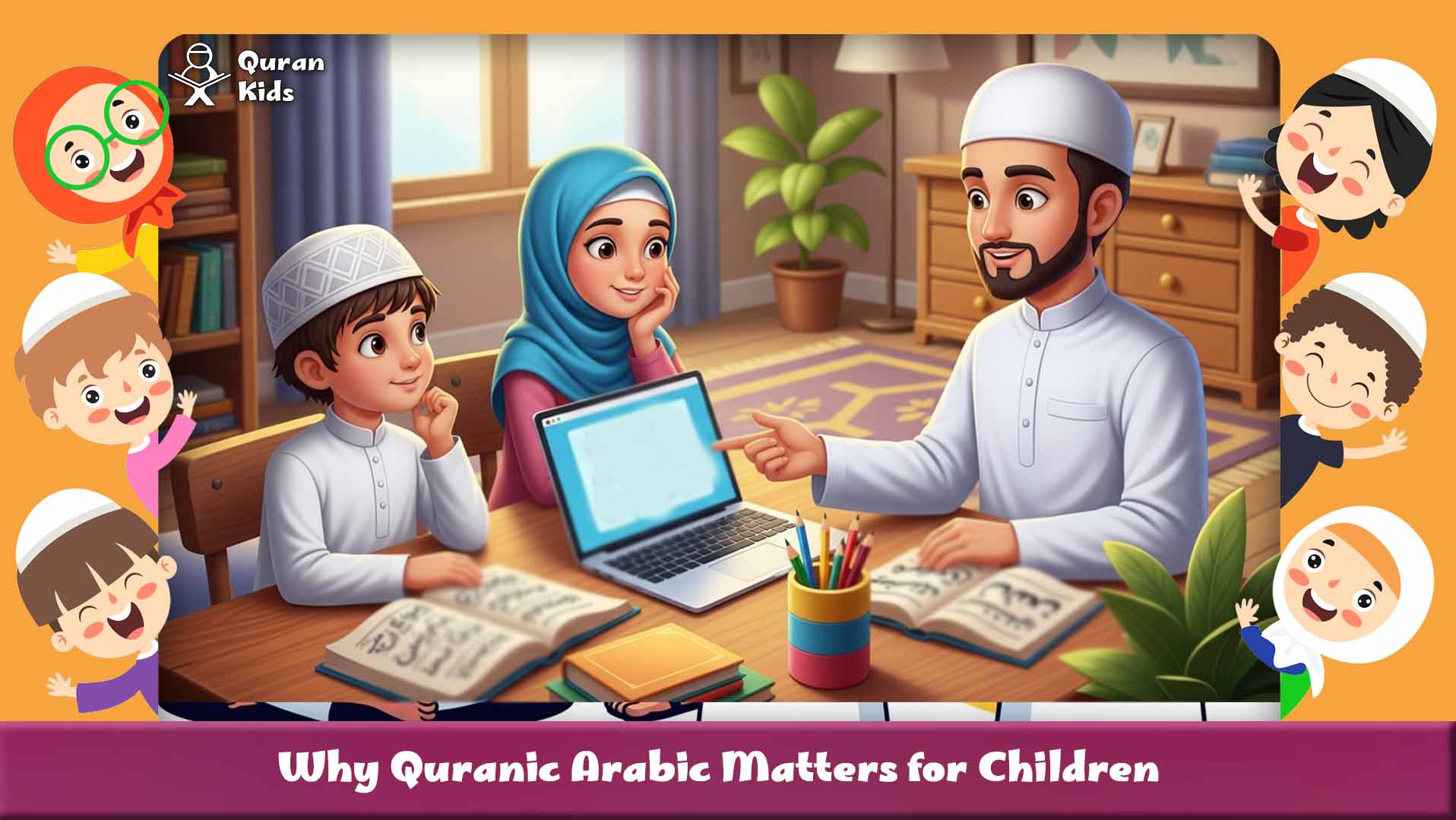
The Quran was revealed in Arabic, and its meaning is inseparable from its language. Translations, however accurate, are interpretations they convey concepts, but they cannot fully capture the precision, depth, and beauty of the original Arabic. When a child learns Quranic Arabic, they gain direct, unmediated access to the word of Allah. This is a profound spiritual and intellectual gift.
Understanding Prayer from the Inside Out
Every Muslim child prays but how many understand what they are saying? A Quranic Arabic course for kids begins to answer that question.
When a child understands that Al-Fatihah is a conversation with Allah, that “iyyaka na’budu” means “You alone we worship,” and that “ihdinaa as-siraat al mustaqeem” is a sincere plea for guidance, this profound knowledge completely transforms their salah. Instead of just repeating words, the child now connects deeply with every verse, experience, and prayer.
Prayer becomes an act of genuine communication rather than a memorized sequence of sounds. This change in the quality of a child’s prayer is among the most powerful outcomes of Quranic Arabic education.
A Deeper Connection to the Quran
Children who understand Quranic Arabic listen to the Quran differently. Where others hear beautiful but opaque sounds, they hear meaning stories, commands, promises, warnings, and the intimate address of their Creator. This understanding produces a love for the Quran that sustains a child’s Islamic commitment throughout adolescence and into adulthood, long after the external pressures of family and community have loosened their hold.
Cognitive and Academic Benefits
Arabic is a morphologically rich language built on a system of three-letter roots from which hundreds of related words are derived. Learning this system trains children to think analytically, recognize patterns, and approach new words with logical deduction rather than rote guessing. These cognitive skills transfer directly to mathematics, science, and other language learning making a Quranic Arabic course for kids not only a spiritual investment but an academic one as well.
Help Your Child Thrive Through Professional Quranic Education
Do you need an interactive, child-friendly online Quran platform that sparks true inspiration in your kids? Our online school offers a secure, positive learning space where children build character and fulfill their spiritual potential.
We encourage you to connect with our global community and feel the difference of qualified, child-centered guidance. Furthermore, our flexible session packages fit effortlessly into your active family lifestyle in Australia or the United Kingdom. Trusting us with your child’s education ensures they carry the holy light of scripture forever.

What a Quranic Arabic Course for Kids Covers
The best academies carefully sequence a well-structured Quranic Arabic course for kids to build competence progressively, starting from the absolute basics and advancing toward genuine reading comprehension and vocabulary mastery. Here is what a comprehensive program typically includes:
The Arabic Alphabet and Script
Every Quranic Arabic course for kids begins with the Arabic alphabet the 28 letters, their forms in isolation and within words, their pronunciation, and the vowel system of fatha, kasra, and damma. Many programs use the Noorani Qaida as a foundational primer, which introduces letters and joining rules in a logical sequence proven across generations of Quran learners. Children who master this stage can read any Arabic text phonetically, which is the essential gateway to everything that follows.
High-Frequency Quranic Vocabulary
The Quran contains approximately 77,000 words, but only around 1,800 unique root words. The 300 most frequently occurring words account for over 70% of the entire text. A smart Quranic Arabic course for kids focuses on these high-frequency words first, allowing children to achieve meaningful comprehension quickly and stay motivated by tangible progress. Words like Allah, rabb, rahman, rahim, salah, jannah, and nar appear hundreds of times each and a child who knows them instantly encounters familiar ground throughout the Quran.
Essential Arabic Grammar (Nahw and Sarf)
Understanding vocabulary alone is not enough a child also needs to understand how Arabic sentences are constructed and how words change form based on their grammatical role. A good Quranic Arabic course for kids introduces the basics of Nahw (Arabic syntax) and Sarf (morphology) in age-appropriate, simplified ways. Children learn the difference between nouns, verbs, and particles; how gender and number are expressed; and how the root system generates families of related words. This grammatical foundation allows a child to decode new words and sentences with increasing independence.
Introduction to Tafsir and Quranic Context
The most advanced stage of a Quranic Arabic course for kids introduces simplified Tafsir the explanation and interpretation of Quranic verses. Children learn not only what individual words mean, but why certain ayahs were revealed, what they require of the believer, and how scholars across history have understood their deeper significance. This contextual understanding is what elevates Quranic knowledge from linguistic skill to genuine Islamic wisdom.
How an Online Quranic Arabic Course for Kids Works
Modern online platforms have made it possible to deliver a genuinely high-quality Quranic Arabic course for kids to any family, anywhere in the world. Here is what the online learning experience typically looks like:
- First and foremost, the most effective format for young learners is live, one-on-one instruction via video call. Through this approach, the teacher can give your child their full attention, adjust the pace in real time, respond immediately to confusion, and provide the kind of personalized encouragement that keeps children engaged and progressing.
- In addition to this, the best online Quranic Arabic courses for kids use digital whiteboards, animated vocabulary flashcards, pronunciation games, and visual story-based grammar explanations to make abstract concepts concrete and enjoyable for young minds.
- Furthermore, a good program relies on a clearly defined syllabus with regular assessments and visible benchmarks. Consequently, parents know exactly what their child has mastered and what comes next at every stage of the course.
- Finally, sessions are available across time zones and throughout the week, thereby allowing families to build a consistent routine that fits around school, extracurricular activities, and family life without compromise.
- Parents receive detailed updates on vocabulary acquisition, grammatical understanding, comprehension milestones, and overall development keeping the entire family informed, involved, and motivated throughout the course.
How to Choose the Right Quranic Arabic Course for Kids
Not all programs are created equal. Here is a practical framework for evaluating your options and choosing the course that will deliver real results for your child.
Verify Teacher Qualifications
The teacher is the single most important factor in any Quranic Arabic course for kids. Look for teachers who hold recognized credentials in Arabic language instruction and Quranic sciences, have specific experience teaching children, and are native Arabic speakers. Ask the academy directly how they verify teacher qualifications, and do not hesitate to request documentation. A reputable program will welcome this scrutiny.
Look for a Child-Centered Pedagogical Approach
Arabic grammar can be dry and abstract when taught to adults. For children, it must be brought alive through stories, games, visual aids, and real-world examples drawn from the Quran and daily Islamic life. A Quranic Arabic course for kids that uses the same textbook-and-drill approach as adult language programs will lose most children within a few weeks. Insist on a program that is specifically designed for young learners, not simply marketed to them.
Always Book a Free Trial Class
A free trial lesson is the most reliable way to assess whether a Quranic Arabic course for kids is right for your child. During the trial, observe how the teacher explains concepts, how they respond to your child’s energy and attention level, and whether your child seems genuinely engaged by the end of the session. Trust what you observe in that first lesson it is the most honest preview of what regular classes will look like.
Supporting Your Child’s Quranic Arabic Learning at Home
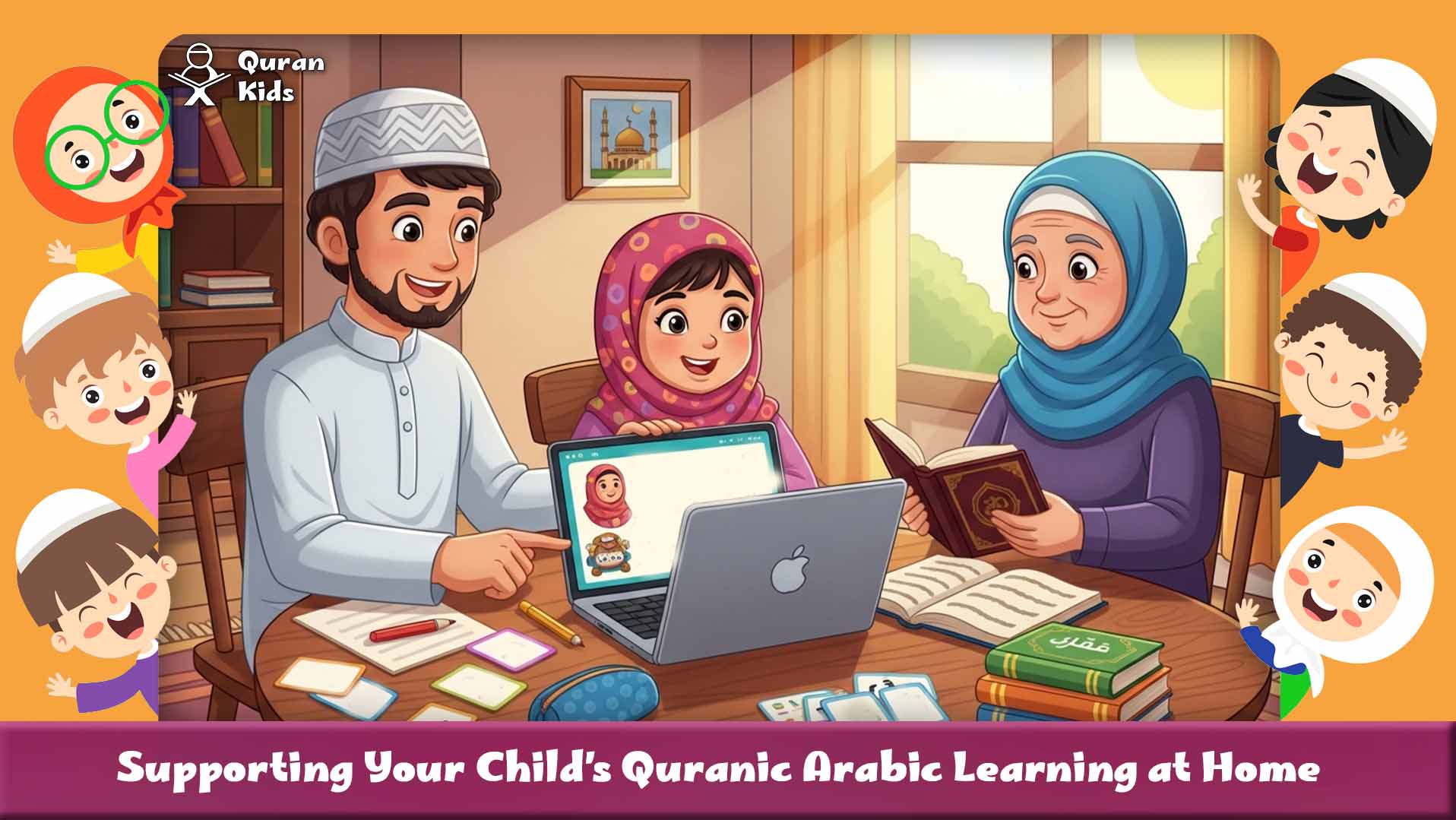
The classroom even the virtual one is only part of the learning journey. Here are the most effective strategies parents can use to reinforce their child’s Quranic Arabic progress in daily family life.
- Each time your child learns a new Quranic word, help them find it in Al-Fatihah or the short surahs they recite in prayer. This immediately anchors the vocabulary in something familiar and spiritually meaningful, dramatically improving retention.
- Incorporate Quranic Arabic words naturally into your family’s daily speech. Saying Alhamdulillah, SubhanAllah, and Inshallah with awareness of their meaning and occasionally explaining that meaning to your child turns everyday moments into language learning opportunities.
- Spend ten minutes a day reviewing vocabulary flashcards with your child. You do not need to know Arabic yourself the act of quizzing your child, listening to their answers, and celebrating correct responses is enough to reinforce the learning and signal that you value their progress.
- Play Quranic recitation at home and occasionally pause to ask your child: “Do you know what that word means?” As their Quranic Arabic grows, these moments of recognition become a powerful source of pride and motivation.
Frequently Asked Questions
Choosing the right educational platform for your children can often bring up many important questions. Therefore, we have compiled the most frequent inquiries from parents to assist you. Read through the following details to confidently start your child’s learning journey.
Q1: At what age can a child start a Quranic Arabic course?
Indeed, academies design most Quranic Arabic courses for kids aged five and above. At this stage, children develop sufficient attention span, basic literacy awareness, and cognitive readiness to engage with structured language instruction. While parents can introduce younger children aged three and four to the Arabic alphabet through play-based approaches, educators generally deliver formal Quranic Arabic study most effectively from age five or six onward. That said, children of any age can begin and make meaningful progress, and it is truly never too late to start. Consequently, many academies offer separate tracks for younger children, older beginners, and students who already possess some Arabic foundation.
Q2: How long does it take to understand basic Quranic Arabic?
With consistent lessons of two to three times per week and daily at-home review, most children develop a working understanding of basic Quranic vocabulary within six to twelve months. Within this timeframe, a child can typically recognize and understand over 200 high-frequency Quranic words, follow the meaning of short surahs they recite in prayer, and begin to identify familiar words throughout the Quran. Full comprehension of the entire Quran is a longer journey usually several years of study but the early milestones arrive quickly and are deeply motivating for both children and parents.
Q3: Should my child learn Tajweed before Quranic Arabic?
Ideally, a child should be able to read Arabic script fluently before beginning a formal Quranic Arabic course, since reading ability allows the child to engage directly with Quranic text. However, academies do not need to teach the two subjects sequentially; instead, many academies offer them simultaneously, running Tajweed and Arabic language lessons in parallel. This parallel approach is highly effective because each subject reinforces the other: Tajweed practice improves pronunciation and reading fluency, while Arabic vocabulary lessons bring immediate meaning to the words a child is learning to recite. Speak with your chosen academy about how they structure their program and which sequence best suits your child’s current level.
Conclusion: Give Your Child the Gift of Understanding
A Quranic Arabic course for kids is one of the most meaningful educational investments a Muslim parent can make. It does not simply teach a language it gives a child access to the direct, unfiltered word of Allah, transforms their experience of prayer, and builds the kind of deep, personal relationship with the Quran that sustains faith through every stage of life.
The rise of online learning has completely dismantled the barriers that once made quality Quranic Arabic education difficult to access—such as the shortage of qualified local teachers, inflexible schedules, and limited child-specific resources. Today, an expert, child-specialist Quranic Arabic teacher can easily guide and support your child wherever you live, at a time that fits your family, and through a curriculum that makes learning genuinely enjoyable.
Use the guidance in this article to evaluate your options carefully, book a free trial class, and trust your instincts as a parent. When your child sits in prayer one day and truly understands the words they are saying to their Lord you will know the journey was worth every effort.