
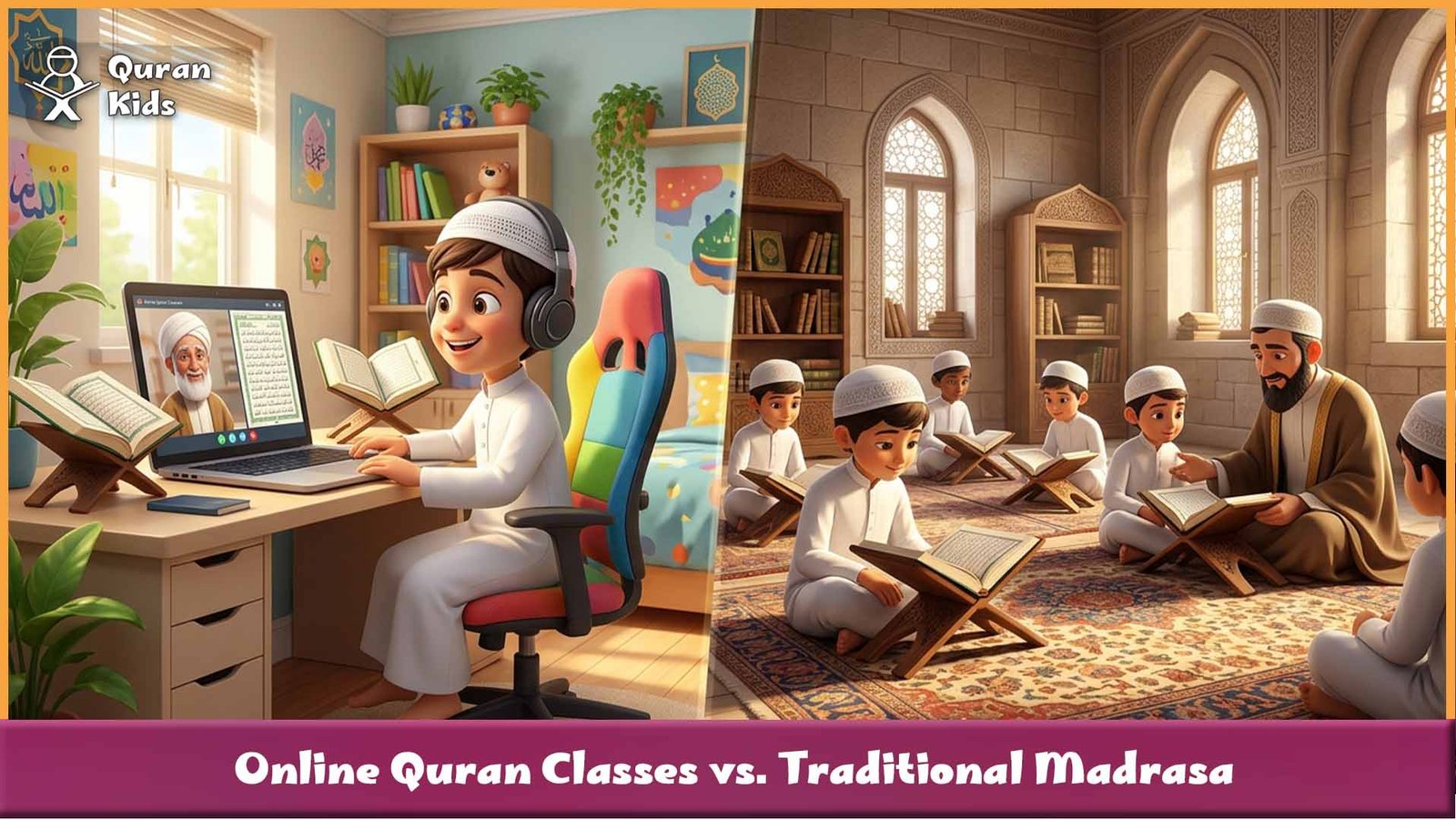
Online Quran Classes vs. Traditional Madrasa: Key Differences
online quran classes vs traditional madrasa is an important comparison for parents who want to choose the right Quran learning environment for their children. Both approaches can help young Muslims learn Quran recitation, understand Islamic teachings, and develop a stronger connection with their faith. However, each method offers a different learning experience.
A traditional madrasa gives children the opportunity to learn alongside other students, meet teachers in person, and become part of a local learning community. In contrast, online Quran classes allow children to study from home, reducing travel time and giving families more flexibility when arranging lessons.
Nevertheless, choosing between these options involves more than deciding whether lessons should happen online or in person. Parents also need to consider teaching quality, individual attention, safety, social interaction, learning progress, and their child’s personality.
Some children enjoy group activities and face-to-face communication. Others feel more comfortable learning individually with fewer distractions. Therefore, the most suitable option depends on the child’s needs and the family’s circumstances.
This guide explores the main differences between online Quran education and traditional madrasa learning. It also explains how parents can evaluate each option and make a thoughtful decision that supports their child’s Quran journey.
How Do Online Quran Classes Differ from Traditional Madrasa Learning?
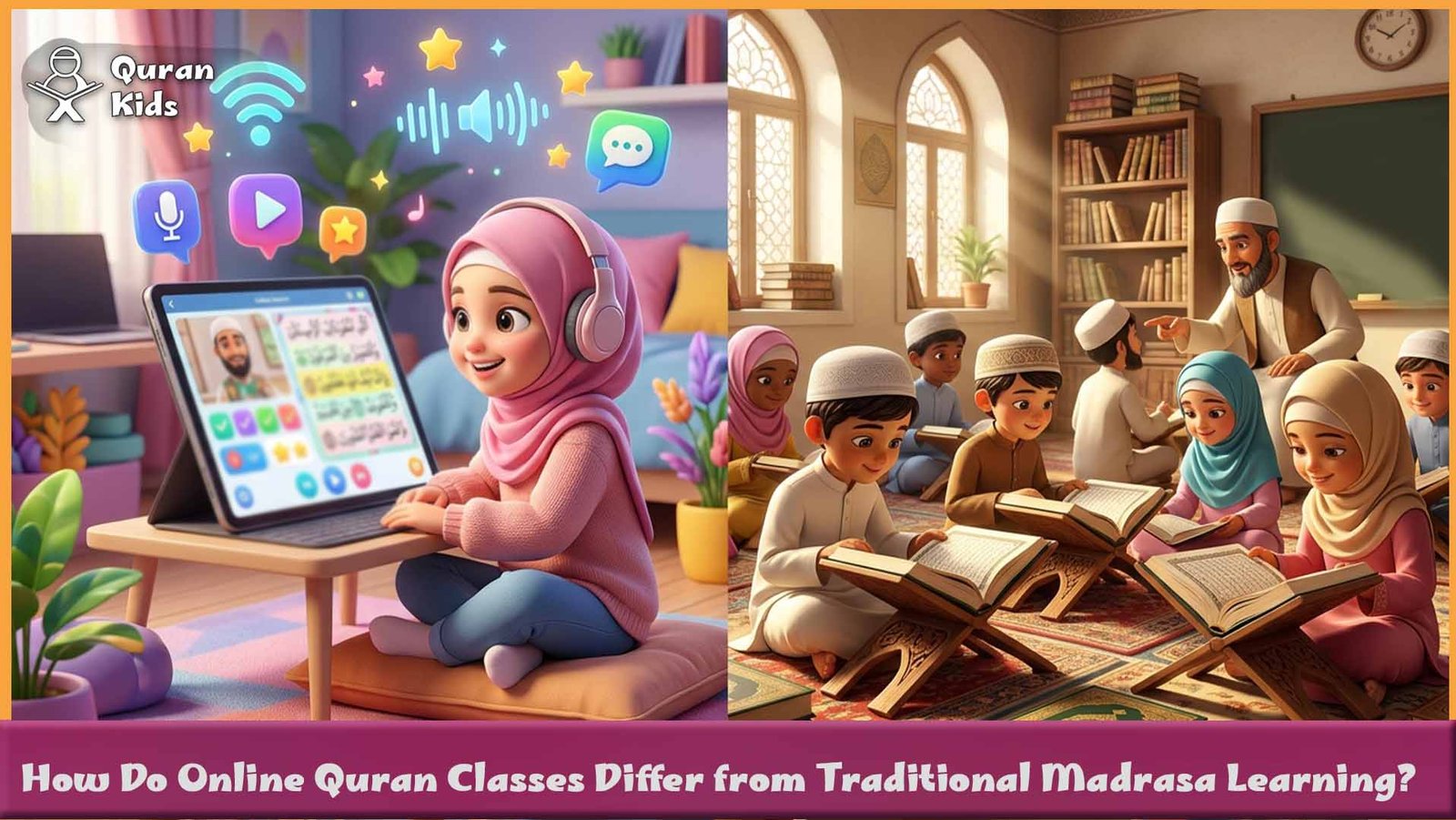
Before choosing a learning method, parents should understand how each educational environment works. Although both options share the goal of teaching the Quran, their daily structure and learning experiences can differ considerably.
A traditional madrasa usually provides lessons at a physical location, such as a mosque, Islamic center, or dedicated educational institution. Children attend scheduled sessions, meet their teachers, and often learn alongside classmates.
Online Quran education uses digital communication tools to connect students with teachers through live lessons. Depending on the program, sessions may involve individual instruction or small groups. Children can participate from home using an internet-connected device.
The following table highlights some important differences.
| Comparison Point | Online Quran Classes | Traditional Madrasa |
|---|---|---|
| Learning location | Usually at home | Physical educational location |
| Transportation | Usually unnecessary | Often requires travel |
| Scheduling | May offer flexible arrangements | Commonly follows fixed schedules |
| Teacher interaction | Online communication | Face-to-face communication |
| Social environment | Depends on the class format | Direct interaction with classmates |
| Individual attention | Can be greater in one-to-one lessons | Depends on class size and teaching method |
| Parental observation | Parents can often remain nearby | Observation depends on institutional policies |
| Learning resources | May include digital materials | May use printed books and classroom materials |
However, these differences do not automatically make one method better than the other. A well-organized madrasa can provide excellent instruction, while an online program may not meet a child’s needs if its teaching approach is unsuitable.
Similarly, the quality of either environment depends on the teacher, curriculum, communication, and consistency of lessons.
Start Learning Tafsir Classes Online Today
If you want to understand the Quran deeply with clear explanations and guided learning, now is the right time to begin your journey. Tafsir Classes Online at Quran Kids Academy provide structured lessons that simplify Quran meanings while helping students apply Islamic teachings in daily life.
In addition, experienced teachers support learners step by step to improve understanding, build confidence, and strengthen spiritual connection with the Quran. Users can also explore more related options.
Therefore, joining today can help you or your children gain authentic knowledge in a flexible and comfortable learning environment. Take the first step now and start building a stronger relationship with the Quran through guided tafsir education.
Individual Attention in Online Quran Classes vs Traditional Madrasa
One of the most important considerations for parents is how much attention their children receive during Quran lessons.
Learning Quran recitation requires more than listening to a teacher. Children need opportunities to pronounce Arabic letters correctly, recognize mistakes, practice Tajweed rules, and repeat difficult passages.
The amount of individual attention can influence how effectively a child develops these skills.
How Do One-to-One Online Quran Classes Compare with Traditional Madrasa Lessons?
In a one-to-one online lesson, the teacher focuses on one student throughout the session. This arrangement gives the child more opportunities to recite and receive direct feedback.
For example, a child may struggle to pronounce certain Arabic letters correctly. The teacher can identify the difficulty, demonstrate the correct pronunciation, and ask the student to repeat the sound.
This process can be particularly useful when children need additional practice with:
- Recognizing Arabic letters and their different forms.
- Pronouncing letters from their correct articulation points.
- Distinguishing between similar Arabic sounds.
- Reading Quranic words without unnecessary hesitation.
- Applying basic Tajweed rules during recitation.
- Memorizing short surahs and reviewing previously learned passages.
In a traditional madrasa, students may learn together in a classroom. This environment can encourage participation and provide opportunities to listen to classmates.
However, the amount of individual practice depends on the number of students, lesson duration, and teacher’s classroom management.
A group of ten children may provide more opportunities for interaction than a larger class. Nevertheless, even a smaller classroom requires the teacher to divide attention among several learners.
Personalized Learning in Online Quran Classes
Children do not all learn at the same speed. Some recognize Arabic letters quickly, while others need additional time to understand pronunciation and reading rules.
Individual instruction can make it easier to adjust the lesson according to these differences.
For example, a beginner may need to spend several sessions reviewing letter recognition before moving to connected words. Another student may already read fluently but require more practice with Tajweed.
A personalized learning approach can help the teacher concentrate on the student’s current level instead of following exactly the same pace for every child.
However, parents should remember that individual lessons are not automatically effective. The teacher still needs a suitable teaching method, clear explanations, and regular opportunities for the child to practice.
Teaching Quality in Online Quran Classes vs Traditional Madrasa
The quality of Quran education depends heavily on the teacher. Whether lessons take place through a screen or inside a classroom, children need accurate instruction and patient guidance.
Parents should therefore evaluate teachers rather than assuming that a particular learning format guarantees better results.
Evaluating Quran Teachers in Online and Traditional Learning Environments
A qualified Quran teacher should understand the subject being taught and explain it in a way that children can follow.
For Quran recitation, relevant teaching abilities include:
- Correct knowledge of Arabic pronunciation.
- Understanding of the Tajweed rules being taught.
- Ability to identify and explain recitation mistakes.
- Patience when working with young learners.
- Clear communication and age-appropriate explanations.
- A structured approach to revision and practice.
Parents can also ask how the teacher assesses a child’s current reading level. This helps determine whether the lessons will begin with basic Arabic reading or focus on more advanced recitation skills.
In a traditional madrasa, parents may have opportunities to meet teachers directly and observe aspects of the classroom environment.
Online learning requires a different evaluation process. Families can ask about the teacher’s qualifications, lesson format, communication arrangements, and procedures for monitoring progress.
Neither format should be judged only by advertisements or general promises. A suitable teacher must demonstrate the knowledge and teaching approach that the child needs.
Scheduling Flexibility: Online Quran Classes vs Traditional Madrasa
Family schedules can strongly influence the choice between online and traditional Quran education.
Children often have school lessons, homework, extracurricular activities, and family responsibilities. Parents may also have work commitments that make transportation difficult. Consequently, the timing and location of Quran lessons deserve careful consideration.
Flexible Online Quran Classes for Busy Families
Online learning can reduce the time families spend travelling to and from a learning center. Children can attend lessons from home, provided they have a suitable device, a reliable internet connection, and a quiet learning space.
This arrangement may help families manage Quran lessons alongside other responsibilities.
For example, parents can look for lesson times that do not conflict with schoolwork or important family activities. They can also consider whether the program offers arrangements that suit the child’s daily routine.
However, flexibility varies between providers. Some online programs have fixed schedules, while others may offer different lesson times.
Parents should confirm the actual scheduling policy before registering. They should also ask how missed lessons, cancellations, and changes are handled.
Traditional Madrasa Schedules and Daily Travel
A traditional madrasa commonly follows established classroom hours. This structure can help children develop a consistent routine because they attend lessons at a regular time and place.
For families living near a suitable madrasa, travel may be straightforward. In other situations, transportation can become a challenge.
Parents should consider:
- The distance between home and the learning center.
- Traffic conditions during lesson hours.
- The time needed to prepare and travel.
- Whether the schedule fits the child’s school commitments.
- The availability of safe and reliable transportation.
A fixed schedule can encourage consistency, but it may become difficult when family circumstances change.
Ultimately, the best arrangement is one that allows children to attend lessons regularly without unnecessary pressure.
Social Interaction in Online Quran Classes vs Traditional Madrasa
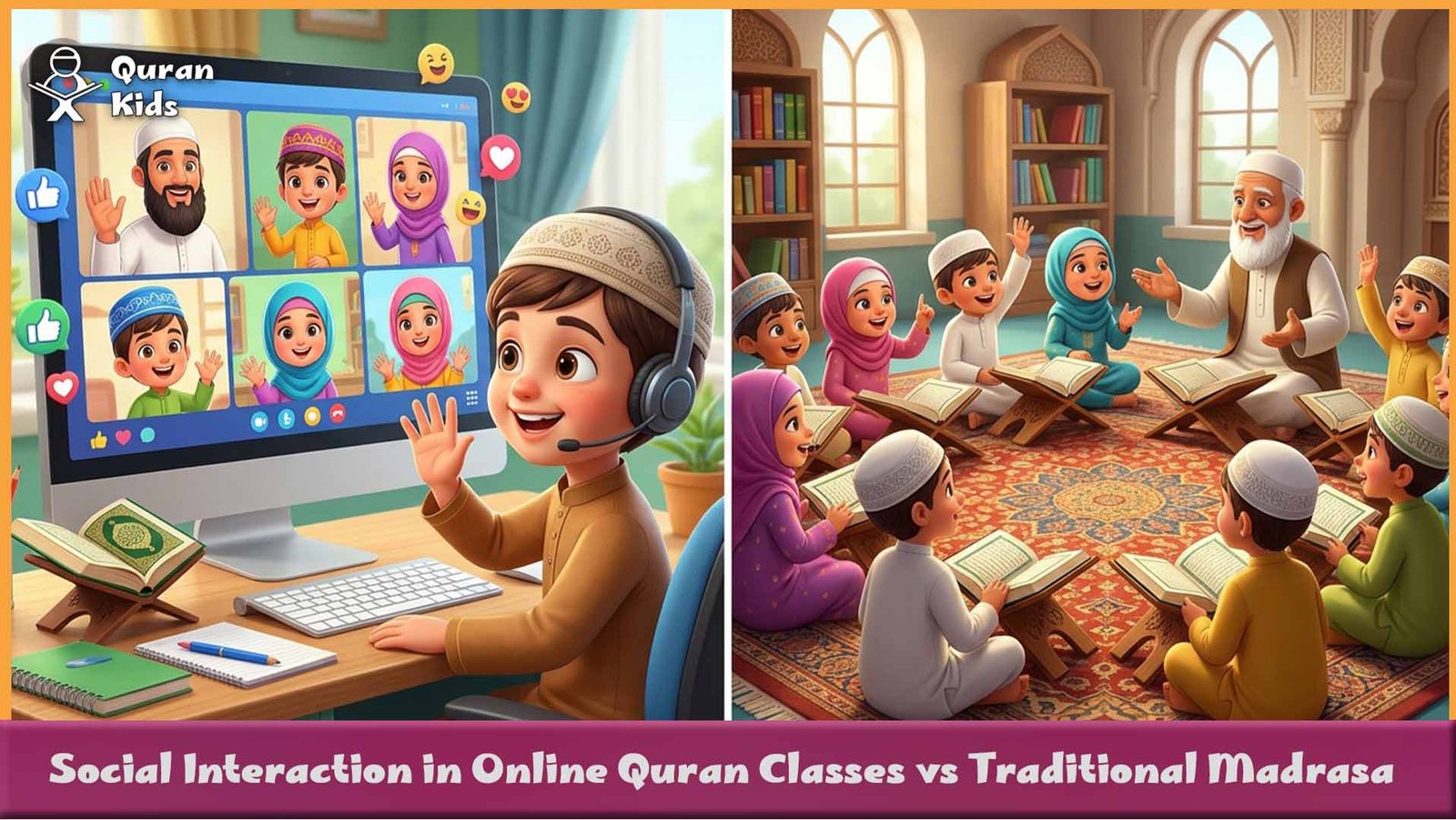
Social development is another important factor when comparing the two learning environments.
Quran education is not limited to reading and memorization. For many families, it also provides opportunities to build friendships, develop good manners, and participate in a supportive Muslim community.
Social Benefits of Traditional Madrasa Education
A traditional madrasa can provide direct interaction with teachers and other children. Students may participate in group recitation, listen to classmates, and learn through shared classroom activities.
These experiences can help children develop communication skills and become more comfortable participating in group learning.
Depending on the institution, children may also take part in activities connected with the local mosque or Islamic community.
Such opportunities can make Quran learning feel like a shared experience rather than an individual academic activity.
However, the quality of social interaction depends on the environment. A positive classroom encourages cooperation and respectful behavior, while poor classroom management may create unnecessary distractions.
Parents should therefore consider the atmosphere, class size, supervision, and opportunities for meaningful participation.
Can Online Quran Classes Provide Social Interaction?
Online learning usually offers fewer opportunities for spontaneous face-to-face interaction. Nevertheless, the experience depends on whether lessons are individual or group-based.
In one-to-one lessons, communication mainly takes place between the student and teacher. This can support focused learning, although it does not provide the same classroom friendships.
Small online groups may allow children to listen to other students, participate in shared activities, and practice together.
Parents can also support social development outside Quran lessons through family activities, mosque visits, community events, and appropriate group learning opportunities.
Therefore, choosing online education does not mean children must miss every opportunity for social interaction. Families simply need to consider how these experiences will be provided.
Child Safety in Online Quran Classes vs Traditional Madrasa
Child safety should be a priority regardless of where Quran lessons take place.Parents sometimes focus mainly on whether a lesson happens at home or in a physical institution.
However, a safe learning environment requires clear supervision, appropriate communication, and responsible safeguarding practices.
Parental Supervision During Online Quran Classes
Online lessons allow parents to remain close to their children during learning sessions. Depending on the child’s age, a parent can stay in the room, observe the lesson, or check in regularly.
This can help younger students feel comfortable while becoming familiar with the online learning process.
Before choosing an online program, parents should ask about:
- Teacher identity verification and qualifications.
- Child protection and safeguarding policies.
- Rules governing communication outside lessons.
- Whether lessons are recorded and how recordings are handled.
- Procedures for reporting inappropriate behavior.
- Parental access to relevant learning information.
Parents should also use suitable privacy settings and avoid sharing unnecessary personal information.
Safety Considerations in a Traditional Madrasa
Physical institutions offer direct supervision within their premises, but parents should still evaluate their safeguarding arrangements.
Important questions include who supervises children, how students enter and leave the building, and whether parents can communicate with the administration.
Families should also understand the institution’s policies for attendance, emergencies, and interactions between teachers and students.
Neither online nor traditional learning should be considered automatically safe. Responsible supervision and transparent procedures are essential in both environments.
Cost Comparison: Online Quran Classes vs Traditional Madrasa
Cost is another practical factor that families should consider before choosing a Quran learning method. Parents comparing different educational options may also explore learn quran online classes to understand the available learning arrangements and determine which option suits their budget.
Some traditional madrasas operate through mosques or community organizations and may provide free or low-cost education. Others charge fees depending on their facilities, teaching arrangements, and educational programs.
Online Quran lessons also vary in price. Costs may depend on lesson frequency, duration, individual or group instruction, and the provider’s arrangements. Families researching online quran courses for kids Australia should also compare the available educational arrangements and consider any additional expenses related to online learning.
Understanding Online Quran Class Fees and Traditional Madrasa Costs
When comparing costs, parents should look beyond the advertised lesson fee. A traditional madrasa may involve additional expenses such as transportation, learning materials, or other institutional charges.
In contrast, an online quran class for kids can eliminate regular travel requirements, although families still need an appropriate device and reliable internet service.
The following checklist can help parents compare the total cost:
| Expense | Online Learning | Traditional Madrasa |
|---|---|---|
| Lesson fees | Depends on the provider | May be free, low-cost, or paid |
| Transportation | Usually unnecessary | May be required |
| Internet access | Necessary | Not usually required for lessons |
| Device | Usually necessary | Not usually necessary |
| Learning materials | May be digital or printed | Often printed or provided by the institution |
| Additional charges | Depend on the provider | Depend on the institution |
Parents should ask for a clear explanation of fees before making a decision.
They should also compare the amount of teaching time, class size, learning support, and educational structure. Families considering an online Islamic school for kids should check which subjects are included and whether the educational program matches their children’s needs.
The lowest price does not always represent the best value. A suitable program should offer appropriate instruction, clear communication, and an arrangement that the family can maintain.
Student Progress in Online Quran Classes vs Traditional Madrasa
Tracking a child’s development is essential for understanding whether Quran lessons are meeting their educational goals.
Without regular feedback, parents may find it difficult to know which skills their children have mastered and which areas still require attention. This becomes particularly important when children study beyond basic recitation and begin exploring Quranic meanings through online quran tafseer classes.
How Online Quran Teachers Track Children’s Progress
Some online learning arrangements make it possible to discuss individual progress directly with the teacher after lessons.
Depending on the provider, progress may be reviewed through lesson notes, reading assessments, memorization checks, or periodic feedback.
Parents can ask whether the teacher monitors areas such as:
Arabic letter recognition.
Reading accuracy and fluency.
Correct pronunciation.
Understanding and applying Tajweed rules.
Memorization of assigned passages.
Revision of previously learned material.
This information can help families understand what the child is currently studying and what comes next.
However, parents should not assume that every online provider uses a formal tracking system. They should confirm which methods are actually available.
Monitoring Progress in a Traditional Madrasa
Traditional madrasas may assess progress through classroom recitation, teacher observation, memorization assignments, and periodic tests.
Teachers can listen to children in person and observe how they participate during lessons. However, the amount of individual feedback depends on class size and the institution’s assessment approach.
Parents can ask how often teachers provide updates and whether they can discuss their child’s difficulties. Regardless of the learning format, progress should be evaluated through practical skills rather than attendance alone.
A child who attends every lesson still needs opportunities to demonstrate accurate reading, improve pronunciation, and revise previously learned material.
Screen Time and Concentration in Online Quran Classes vs Traditional Madrasa
One concern parents may have about online Quran education is the amount of time children spend using digital devices.
Children already use screens for schoolwork, entertainment, and communication. Adding Quran lessons may increase their daily screen exposure. This concern deserves attention, especially for younger learners.
Helping Children Focus During Online Quran Classes
The quality of the learning environment can influence how well a child concentrates during an online lesson.A quiet room, suitable lighting, and a comfortable seating arrangement can make lessons easier to follow.
Parents can also help by preparing the child before the session begins. Useful steps include:
- Choose a quiet place away from television and unnecessary noise.
- Prepare the Quran or learning materials before the lesson.
- Check the internet connection and device in advance.
- Remove unrelated applications and notifications where possible.
- Use lesson durations that suit the child’s age and attention span.
- Encourage short breaks when appropriate.
- Remain available to help younger children with technical difficulties.
Parents should also discuss screen time with the teacher when planning lesson frequency and duration.
Why Traditional Madrasa Lessons May Feel Different
A physical classroom provides a learning environment without requiring a screen for the lesson itself.
Children can interact directly with the teacher, handle printed materials, and participate in classroom activities.
This may suit students who find digital learning distracting or prefer face-to-face communication. Nevertheless, traditional lessons can also involve distractions, especially in crowded classrooms.
The important question is not simply whether a screen is used. Parents should consider which environment helps their child remain attentive and participate actively.
Choosing Between Online Quran Classes and a Traditional Madrasa
After comparing the main differences, parents can evaluate which learning environment better matches their child’s needs.
There is no universal answer because children have different personalities, learning preferences, and family circumstances.
When Online Quran Classes May Be a Suitable Choice
Online Quran education may be worth considering when students need flexible schedules, prefer learning from home, require personalized lessons, or live far from qualified Quran teachers.
- The family lives far from a suitable Quran learning center.
- Transportation creates difficulties.
- The child benefits from individual instruction.
- The family needs lesson times that fit a busy routine.
- Parents prefer to remain nearby during lessons.
- The child feels more comfortable learning in a familiar environment.
- A suitable teacher or program is available online.
For example, a child who needs additional help with Arabic pronunciation may benefit from individual lessons that provide repeated practice.
Similarly, families with demanding schedules may find home-based lessons easier to organize.However, parents should first confirm the teacher’s qualifications, teaching method, and lesson arrangements.
When a Traditional Madrasa May Be the Better Option
A traditional madrasa may be suitable when students prefer face-to-face teaching, structured classroom lessons, regular attendance, direct teacher interaction, and opportunities to learn alongside other students in person.
- A reputable institution is located nearby.
- The child enjoys learning with classmates.
- Face-to-face interaction is an important priority.
- The family prefers an established classroom routine.
- The institution provides appropriate supervision.
- The available teaching arrangements meet the child’s needs.
- The cost and transportation requirements are manageable.
For children who enjoy group activities, a traditional classroom can make Quran learning more interactive. It may also provide opportunities to develop friendships and participate in a local Muslim community.
Nevertheless, parents should visit the institution when possible and understand its teaching approach before enrolling their child.
Combining Online Quran Classes with Traditional Madrasa Education

Parents do not always need to choose only one learning method. In some families, combining online Quran instruction with activities at a local mosque or Islamic center may provide a balanced educational experience.
For example, a child may attend individual online lessons to improve reading accuracy and receive additional opportunities for group interaction through community activities.
This arrangement can address different educational needs without expecting one environment to provide every benefit.
Creating a Balanced Quran Learning Routine
A balanced routine should be realistic and suitable for the child’s age, school commitments, and current Quran level.
Parents can consider the following approach:
- Schedule regular Quran lessons with a suitable teacher.
- Set aside short periods for daily reading practice.
- Review previously learned passages consistently.
- Encourage participation in appropriate mosque activities.
- Discuss learning difficulties with the teacher.
- Avoid scheduling so many activities that the child becomes overwhelmed.
For example, a beginner may need more time for Arabic letter recognition and pronunciation practice. A child who already reads fluently may benefit from additional Tajweed practice and memorization revision.
The routine should develop gradually as the child’s abilities improve. Most importantly, Quran learning should remain a positive and meaningful experience rather than becoming a source of constant pressure.
Choosing Online Quran Classes with Quran Kids Academy
When exploring online Quran education, parents should carefully evaluate the educational provider and determine whether its arrangements match their child’s needs.
Quran Kids Academy is a name parents may consider researching when exploring online Quran learning options. However, a responsible decision requires checking the actual courses, teaching arrangements, and policies available directly from the academy.
Rather than relying only on general descriptions, families should look for clear information about the educational experience.
What Parents Should Check Before Choosing Quran Kids Academy
Before making a decision, parents can use the following questions to evaluate whether the available learning arrangements are suitable:
- 1. What Quran subjects are available?
Ask whether the available lessons cover the subjects your child needs, such as Arabic reading, Quran recitation, Tajweed, or memorization. The exact curriculum should be confirmed directly. - 2. Who teaches the lessons?
Find out about teachers’ Quran qualifications, teaching experience, and ability to work with children at different learning levels. - 3. How are lessons organized?
Clarify whether lessons are individual or group-based, how long they last, and how frequently students are expected to attend. - 4. How is progress communicated to parents?
Ask whether parents receive feedback about reading accuracy, pronunciation, memorization, and areas that require additional practice. - 5. What child protection arrangements are available?
Understand the academy’s communication policies, supervision procedures, and safeguarding arrangements before registration. - 6. What are the fees and scheduling conditions?
Request accurate information about available schedules, payment arrangements, missed lessons, and any additional costs.
These questions help parents make an informed decision instead of choosing a provider based on its name alone.
Matching the Learning Program to Your Child’s Level
Children need different types of Quran instruction depending on their previous experience. A beginner may need to learn Arabic letters and basic reading skills before starting regular Quran recitation.
Another child may already read Quranic passages but need help applying Tajweed rules correctly. A student who has memorized several surahs may require a structured revision approach to maintain what has already been learned.
When evaluating Quran Kids Academy, parents should explain their child’s current level and ask how the available lessons address those needs.
The purpose is to find an educational arrangement that matches the child’s abilities rather than placing every learner on the same learning path.
Keeping Parents Involved in Quran Education
Parental involvement remains important even when a qualified teacher leads the lessons. Parents can encourage children to prepare for sessions, complete appropriate practice, and review previously learned material. They can also communicate with the teacher when the child experiences difficulties or loses motivation.
Families researching Quran Kids Academy should clarify how parents can follow the learning process and communicate with the relevant educational staff. Clear expectations can help create a positive relationship between the family, teacher, and student.
Common Mistakes When Choosing Online Quran Classes vs Traditional Madrasa
Choosing a Quran learning environment requires careful consideration. Some parents focus on one attractive feature and overlook other factors that may influence their child’s experience. Avoiding common mistakes can make the decision more practical.
Choosing Based Only on Price
A low-cost program may appear attractive, but parents should also consider teaching quality, lesson duration, class size, and available support.
Likewise, a higher price does not automatically guarantee better teaching. Compare the complete educational arrangement before making a financial decision.
Assuming Every Online Lesson Is Individual
Some online programs offer one-to-one lessons, while others use group instruction. Parents should confirm the class format instead of assuming that all online education provides personal attention.
This distinction matters because the amount of individual speaking and correction time can vary considerably.
Ignoring the Child’s Learning Preferences
A child who enjoys group activities may not immediately feel comfortable with individual screen-based lessons.
Similarly, a child who becomes distracted in crowded classrooms may prefer a quieter learning environment. Parents should consider the child’s personality while remaining open to helping them develop new learning skills.
Overlooking Teacher Qualifications
A convenient schedule and attractive website cannot replace accurate Quran instruction. Parents should verify relevant qualifications and ask how teachers correct pronunciation and explain Tajweed. The teacher’s ability to communicate patiently with children is also important.
Expecting Immediate Results
Learning Quran recitation takes consistent practice. Children need time to recognize letters, develop pronunciation skills, and apply new rules.
Parents should avoid comparing their child’s progress with that of other students. Instead, they should focus on gradual improvement and regular revision.
Failing to Establish a Home Learning Routine
Even good lessons may produce limited progress when children rarely practice between sessions. A realistic routine can help reinforce what students learn during class.
Short and consistent practice is often easier for children to maintain than long, irregular study sessions.
Creating a Successful Quran Learning Routine with Online Quran Classes
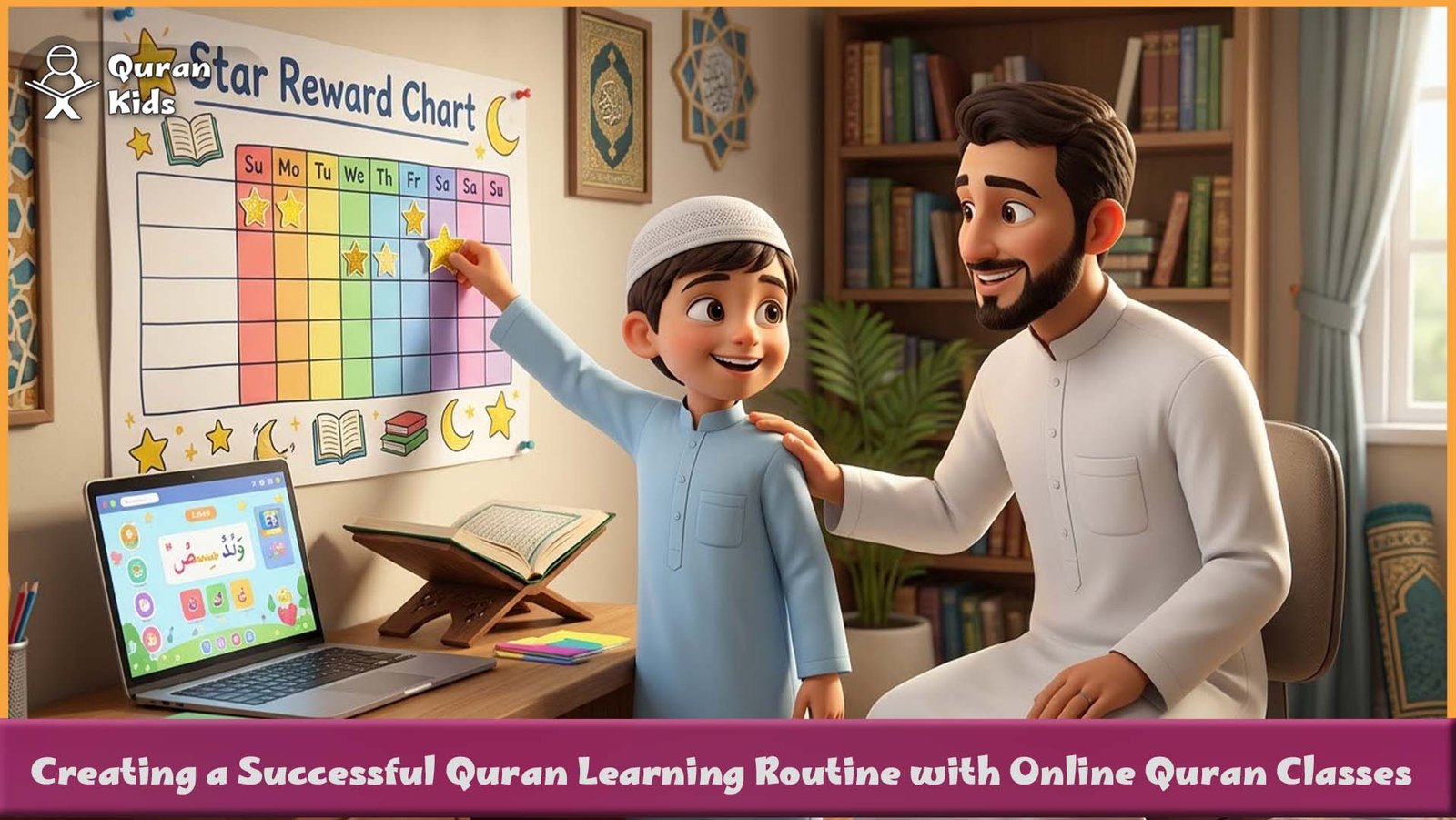
A successful Quran learning routine should be consistent, manageable, and appropriate for the child’s current abilities.
Parents do not need to create a complicated timetable. A simple plan can provide enough structure to support regular learning.
Set Clear and Age-Appropriate Learning Goals
Start by identifying what the child needs to learn. For example, a beginner may focus on recognizing Arabic letters, while an intermediate student may work on improving recitation accuracy.
A child learning memorization may need separate goals for new passages and revision. Clear goals make it easier for parents and teachers to understand what each lesson should accomplish.
Make Daily Practice Manageable
Children may find it difficult to maintain long study sessions after a full school day. Instead, families can arrange short practice periods that fit naturally into the daily routine.
These sessions may include:
- Reviewing Arabic letters or reading exercises.
- Reciting a short Quranic passage.
- Repeating words that were difficult during the lesson.
- Revising previously memorized surahs.
- Practicing a Tajweed rule introduced by the teacher.
The exact activities should match the child’s level and the teacher’s instructions.
Encourage Children Without Creating Pressure
Positive encouragement can help children develop confidence and motivation. Parents can recognize improvements in pronunciation, reading fluency, and consistency.
They should also allow children to make mistakes during practice because correcting mistakes is part of learning. If a child becomes tired or frustrated, it may be helpful to review the lesson schedule and workload.
The goal is to build a lasting relationship with Quran learning rather than achieve short-term progress through excessive pressure.
Review Progress Regularly
Parents should periodically discuss the child’s development with the teacher. Useful questions include:
- Which reading skills have improved?
- Which pronunciation mistakes still need attention?
- Is the child ready to move to the next learning level?
- What should be reviewed at home?
- Are the current lesson duration and frequency suitable?
These discussions help families understand whether the learning approach remains appropriate. They also provide an opportunity to adjust goals when the child’s needs change.
Frequently Asked Questions About Online Quran Classes vs Traditional Madrasa
Choosing between online and traditional Quran education can raise additional questions for parents. The following answers address practical concerns that may influence the final decision.
1. At What Age Can Children Start Learning Quran Online?
There is no single starting age suitable for every child. Readiness depends on attention span, communication skills, familiarity with basic learning activities, and the ability to follow simple instructions.
Parents should consider whether their child can participate comfortably in a lesson and use the required device with suitable supervision.
Younger children may need shorter sessions and more parental support. A teacher can also help assess whether the child is ready for structured Quran instruction.
2. Should Parents Stay With Their Children During Online Quran Lessons?
Parental involvement depends on the child’s age, independence, and the provider’s safeguarding arrangements.
Younger children may benefit from having a parent nearby to help with technical issues and maintain attention.
Older children may gradually become more independent, provided appropriate supervision and communication policies are in place.
Parents should discuss the expected level of involvement with the educational provider before lessons begin.
3. What Should Parents Do If Their Child Loses Interest in Quran Lessons?
First, try to understand why the child has lost interest. The lesson may be too difficult, too long, or unsuitable for the child’s current learning level.
Parents can discuss the situation with the teacher and consider adjusting lesson duration, activities, or practice expectations. Encouragement, achievable goals, and regular positive feedback can also help restore motivation.
Children should feel supported throughout their learning journey rather than pressured to progress faster than they can manage.
4. Can a Child Change from a Traditional Madrasa to Online Quran Learning?
Yes. A child can move from traditional classroom learning to online instruction when the new arrangement better suits the family’s circumstances or educational needs.
However, parents should first identify the child’s current Quran level and explain what has already been studied.
This helps the new teacher understand which skills the child has developed and which areas need further practice.
A careful transition can prevent unnecessary repetition and make it easier to continue learning with a clear plan.
Conclusion
Choosing between online Quran education and a traditional madrasa requires parents to consider their child’s educational needs, personality, family routine, and learning environment.
A traditional madrasa can provide face-to-face interaction, classroom friendships, and a connection with the local Muslim community. Online learning can offer greater convenience, reduce transportation requirements, and provide opportunities for individual instruction when that format is available.
Neither approach is automatically better for every child. The quality of teaching, appropriate supervision, consistent practice, and communication with parents remain essential regardless of the learning method.
Before making a decision, compare the available teachers, lesson structures, schedules, costs, and safeguarding policies. You can also consider combining online instruction with activities at a local mosque or Islamic center when this arrangement suits your family.
If you are researching Quran Kids Academy, verify its current courses, teachers, lesson arrangements, and policies directly before registering. A careful evaluation will help you determine whether its educational approach matches your child’s needs.
Ultimately, the best Quran learning environment is one that helps your child develop accurate recitation, build confidence, and maintain a consistent connection with the Quran.


