Tajweed Rules of the Quran: A Complete Guide for Beginners 2026
quran kids simplifies the often-challenging study of the tajweed rules of the quran for children, making correct recitation accessible globally. Our online tajweed academy is designed exactly for this, pairing each child with a tutor who corrects recitation in real time.
This comprehensive guide introduces fundamental Tajweed concepts. It provides a clear pathway for young learners in London and across the UK to recite the Holy Book beautifully and accurately. Mastery of these rules preserves the integrity of the divine message. Our Quran with tajweed online classes apply these same rules in live, one-on-one sessions.
Understanding the Essence of Tajweed in Quranic Recitation
Tajweed (تَجۡوِيد) is an Arabic word that literally translates to “betterment” or “improvement.” However, within Islamic science, it refers to the specialized art of proper Quranic recitation.
Why Mastering Tajweed is an Indispensable Science
The core purpose of Tajweed is to protect the recitation of the Holy Quran from linguistic or phonetic errors. This ensures the reader pronounces every letter correctly from its precise point of articulation. Therefore, the science of Tajweed guarantees the integrity and intended meaning of the divine text.
Furthermore, reciting the Quran with care is a great act of worship for Muslims. Consequently, learning the it quran becomes a spiritual necessity, not just an academic endeavor.
Start Your Child’s Journey to Flawless Recitation
Are you searching for expert instruction in the Tajweed rules of the quran for your child in London or elsewhere in the UK, USA, or Canada? Stop relying on self-learning and secure a spot with certified experts. quran kids provides personalized, one-on-one Tajweed courses designed specifically for young learners.
We simplify complex rules like Noon Sakinah and Meem Sakinah using engaging methods. Ensure your child preserves the beauty and meaning of the Holy Quran by enrolling them with a qualified tutor today. Try our online Quran classes for kids Today!
Online Quran Academy
quran kids is a premier online platform dedicated to teaching the Quran and its authentic recitation methods, including the comprehensive this program quran, primarily to children. We focus on students aged four to sixteen, offering a highly personalized and supportive learning environment.
Our academy connects young learners with expert instructors, many of whom hold Ijazah (certification) and are graduates of renowned Islamic universities.
Our Commitment to Authenticity and Accuracy
We ensure that every child receives guidance from a teacher whose knowledge chain is traced back through generations of scholars. Our dedicated tutors possess a strong command of the Arabic language and Tajweed science.
Specifically, the one-on-one format allows the tutor to focus entirely on the child’s pronunciation and correct any subtle errors in real-time.
Therefore, this commitment to authenticated learning ensures that the child masters the tajweed rules of the quran correctly. This high standard of instruction is available to families globally.
learn more: Quran for Kids
Fundamental Rules Governing Noon Sakinah and Tanween
Among the most detailed areas within the tajweed rules of the quran are the four specific rulings related to Noon Sakinah and Tanween. Understanding these rules is essential for smooth and melodious recitation.
Defining Noon Sakinah and Tanween
These two concepts, though similar in sound, have distinct functions in Arabic phonology that dictate how they are recited.
Noon Sakinah refers to the letter Noon (ن) when it carries a Sukūn (pause or absence of a vowel). Tanween (ً ٍ ٌ) is a diacritic sign added to the end of a noun to indicate an indefinite Noon sound.
Therefore, both result in a Noon sound that is subject to the same four specific rules when followed by certain letters. Consequently, mastery of these rules dramatically improves fluency in the tajweed rules of the quran.
The Four Key Rulings for Noon Sakinah and Tanween
The subsequent letter dictates whether the sound is cleared, merged, converted, or concealed.
Izhaar (إظۡهار): This means clear pronunciation. It occurs if the Noon Sakinah or Tanween is followed by any of the six throat letters [ء ه ع ح غ خ]. The sound of the Noon is pronounced clearly and distinctly without a nasal tone.
Idghaam (إدۡغَام): This means merging. It occurs if followed by the letters [ي ر م ل و ن]. The Noon sound merges completely with the following letter, often resulting in Ghunnah (nasal sound) or sometimes merging without it.
Iqlab (إقلاب): This means conversion or substitution. It occurs when the Noon Sakinah or Tanween is followed only by the letter Baa (ب). The Noon sound is converted into a Meem sound, often with a slight nasal tone.
- Ikhfaa (إخفاء): This means hiding or concealment. It applies when the Noon Sakinah or Tanween is followed by any of the remaining 15 letters. The Noon sound is concealed to a certain extent, not fully silent, producing a light nasal sound.
Another vital set of this program quran focuses specifically on the letter Meem (م) when it has a Sukoon. This letter’s proximity to other letters governs three distinct recitation rulings.
Defining Meem Sakinah and its Three Cases
Meem Sakinah is the letter Meem (م) with a Sukūn sign on it, and its subsequent recitation depends entirely on the letter immediately following it.
The rules related to Meem Sakinah are distinct from those governing Noon Sakinah and Tanween. Specifically, scholars term these rules “Labial” (Shafawy) because the Meem is articulated from the lips. Therefore, there are three possibilities: merging (Idgham), hiding (Ikhfaa), or clarity (Izhaar).
Consequently, mastering these subtle variations is key to accurate and smooth recitation of the these classes quran.
learn more: Quran Translation for Kids
The Three Labial Rulings (Shafawy) for Meem Sakinah
These three rulings cover every possible letter combination following a Meem Sakinah.
Idgham Shafawy (Labial Merging): This occurs only when another Meem falls immediately after the Meem Sakinah. The two Meems merge completely, and a full Ghunnah (nasal sound) is pronounced.
Ikhfaa Shafawy (Labial Concealment): This occurs only when the letter Baa (ب) falls immediately after the Meem Sakinah. The Meem sound is concealed or hidden lightly, accompanied by a full Ghunnah.
Izhaar Shafawy (Labial Clarity): This occurs when any of the remaining letters of the Arabic alphabet fall after the Meem Sakinah. The Meem is pronounced clearly and distinctly with a slight Ghunnah.
The Rules of Qalqalah and Noon/Meem Mushaddadah
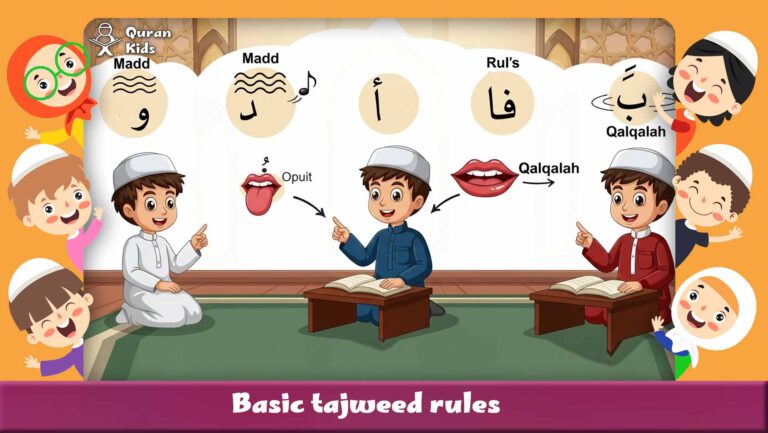
Two more essential tajweed rules of the quran involve creating an ‘echoing’ sound on specific letters and the doubling of the Noon and Meem letters when they carry a Shaddah. These rules add rhythm and melody.
Qalqalah: The Echoed Letters
Qalqalah (القلقلة) is a unique rule that occurs when one of five specific letters has a Sukūn (silent mark) over it.
The five letters involved are remembered by the phrase (ق ط ب ج د). Specifically, when these letters are Sakin, they are pronounced with an echoing or bouncing sound. Therefore, if the Qalqalah letter is in the middle of a word, the bounce is lighter.
Conversely, if it appears at the end of a word, the bounce is stronger. This distinctive sound is mandatory and adds a rhythmic quality, making it a critical part of the tajweed rules of the quran.
Doubling Noon and Meem Mushaddadah
When the letters Noon or Meem carry a Shaddah (ــّـ), they are pronounced with emphasis and a prolonged nasal sound.
Noon Mushaddadah and Meem Mushaddadah must both be pronounced for the duration of a full Ghunnah. Consequently, the letter is effectively doubled in sound.
Furthermore, this rule is considered one of the easiest and most frequently encountered in the such a course quran. Therefore, practicing the correct nasal duration for these two specific letters quickly improves the beauty and accuracy of the student’s recitation.
The Extensive Rulings of Madd (Vowel Lengthening)
Madd (المدّ), meaning lengthening or elongation, is one of the most comprehensive and critical sections within the these classes quran. It governs how long vowel sounds must be extended during recitation.
Classifying Madd: Original and Secondary Lengthening
Madd is broadly classified into two primary categories based on the cause of the elongation.
Al-Madd Al-Asli (Original Lengthening): This is the natural prolongation of a long vowel sound (ا – و – ي) for two beats. It occurs when the long vowel is not followed by a Hamzah (ء) or a Sukoon.
Al-Madd Al-Farʿiee (Secondary Lengthening): This type is caused when a Hamzah or a Sukoon falls after the long vowel. Consequently, the duration of the elongation extends beyond the original two beats. This is a foundational concept when learning the tajweed rules of the quran.
Understanding Four and Six Beat Madd
The maximum duration for vowel lengthening is determined by the specific condition causing the secondary Madd.
Four Beat Madd: This often applies to types like Madd Al-Wajib Al-Muttasil (Joined Lengthening) where the Hamzah is in the same word as the long vowel. It also applies to Madd Al-Ja’iz Al-Munfasil (Separate Lengthening) where the Hamzah is in the next word.
Six Beat Madd: This duration is often compulsory (Madd Al-Lazim). It is primarily caused by a Sukoon falling after the long vowel. This compulsory Madd ensures the meaning is preserved. This level of detail confirms the depth of the this option quran.
How Can I Master Letter Pronunciation (Makharij)?
Mastering the articulation points (Makharij al-Hurūf) is absolutely foundational, as correct pronunciation preserves the Quran’s meaning and beauty. Even small errors can drastically alter the divine message.
Identifying the 17 Articulation Points
Arabic letters originate from specific points across the throat, tongue, lips, and nasal cavity. The Arabic language has 17 unique articulation points. For example, the letter Ḍhād (ض) comes from the side of the tongue touching the upper teeth.
Conversely, the letter Zhā’ (ظ) comes from the tip of the tongue touching the front teeth. Therefore, confusing these two letters changes the meaning of the word entirely. Consequently, beginners must spend significant time isolating and practicing each letter with a qualified tutor who can correct them instantly. This detailed work is essential for anyone starting the tajweed rules of the quran.
learn more: perfect quran recitation
Why Is a Qualified Teacher Essential for Tajweed?
Learning the such a course quran correctly cannot be accomplished through self-study alone; it requires authentic, real-time guidance from an expert. The subtle phonetic differences demand personalized correction.
The Necessity of Ijazah-Certified Instruction
A qualified Tajweed teacher should ideally possess an Ijazah (certification).The Ijazah confirms that the teacher has recited the entire Quran with perfect Tajweed to their own certified teacher. Therefore, this provides an unbroken chain of narration back to the Prophet (PBUH).
Consequently, for parents in London, the UK, or the USA, choosing a certified online tutor ensures the child receives the most authentic and accurate instruction in the this quran. The tutor’s immediate feedback prevents the young learner from forming ingrained errors.
What is the Historical Origin of the Tajweed Rules?
The formal documentation of the tajweed rules of the quran became necessary centuries after the Prophet’s (PBUH) era, as Islam spread widely and non-Arabs began reciting the Holy Book.
Documenting the Science for Preservation
Early Muslims learned the Quran’s recitation directly from the Prophet (PBUH) without written rules. As Islam reached diverse regions and many non-Arabs embraced the faith, linguistic errors began to appear in the recitation. Therefore, scholars felt a necessity to document the correct recitation styles.
Specifically, Abu Ubaid al-Qasim bin Salam was among the first to gather these rules in his book al-Qiraat. Consequently, this intellectual effort preserved the authentic method of recitation for all time. Understanding this history highlights the importance of the tajweed rules of the quran.
How Can Diagrams and Practice Aid Tajweed Memorization?
Effective memorization of the it quran involves engaging both the auditory and visual senses. Simple tools can make complex rules stick.
Utilizing Visual and Auditory Aids
Combining practice with visual cues significantly enhances retention, especially for young students in places like Canada.
Drawing the Tajweed signs and symbols, such as Sukoon, Shaddah, and the different Madd symbols, helps create a visual memory.
Furthermore, practicing recitation as much as possible is the ultimate way to internalize the rules.
- Consequently, improving listening skills by repeatedly listening to high-quality audio recordings from renowned Qaris is also vital. This auditory practice helps students replicate the correct accent and rhythm, which is a major part of the this option quran.
What are the Main Symbols Used in Tajweed?
The Quranic text utilizes specific symbols and diacritical marks that alert the reader to the required tajweed rules of the quran at that exact point. Recognizing these symbols is the first step in applying the rule.
Key Diacritical Marks and Stopping Signs
Recognizing these symbols, which differ slightly from standard Arabic script, is a prerequisite for correct recitation.
Sukoon: In the Quran, the Sukoon (silence mark) is often represented by a small head of the letter ħā (ۡ).
Shaddah (ــّـ): This small ‘W’ shape indicates that the letter must be doubled, often with a Ghunnah if it is a Noon or Meem.
Madd (~): The horizontal tilde indicates that the long vowel beneath it must be elongated more than the usual two beats.
Tanween (ً ٍ ٌ): These double marks signal a Noon Sakinah rule is applied.
Stopping and Pausing Signs: Symbols like مـ (Mandatory Stop) and لا (Mandatory Continuation) guide the reader on where to take a breath without altering the meaning of the verse.
FAQ: Essential Questions on this Quran
This section answers common questions raised by parents in London and the diaspora who are seeking instruction in the Tajweed science for their children.
1- Is learning the these classes quran mandatory for all Muslims?
While the core principle is to recite the Quran as purely and correctly as possible, learning the basic Tajweed rules is widely considered mandatory (Fardh ‘Ayn) to avoid major pronunciation errors that could change the meaning. For example, confusing a heavy letter with a light one. These rules help preserve the integrity of the text.
2- How does Tajweed improve a child’s understanding of the Quran?
Tajweed improves understanding by ensuring that the child is pronouncing the words exactly as intended. Correct articulation prevents misinterpretation of words that look similar but have different Makharij (articulation points). Furthermore, the melodious and measured recitation enhances the spiritual and emotional connection to the divine text.
3- What is the difference between Idgham with Ghunnah and without Ghunnah?
Idgham (merging) occurs when Noon Sakinah or Tanween is followed by the letters [ي ر م ل و ن]. It is performed with Ghunnah (nasal sound) when followed by [ي م و ن]. It is performed without Ghunnah when followed by [ر ل]. This distinction maintains the required rhythmic flow.
4- Can learning Tajweed help improve general Arabic communication skills?
Yes, mastering Tajweed significantly helps improve general Arabic communication skills. Tajweed focuses intensely on the precise articulation points of all Arabic letters. This disciplined practice strengthens the child’s mouth muscles and ear for subtle sounds. This highly accurate pronunciation foundation is transferable to speaking Modern Standard Arabic.
5- What does it mean to get Ijazah in Tajweed?
Receiving Ijazah in Tajweed means the student has gained a certified license or permission to teach and narrate the Quran. To achieve this, the student must typically recite the entire Quran, with all Tajweed rules applied perfectly, from memory to a certified Shaykh. This certification is a great honor and ensures the continuation of authentic knowledge.
6- How long does it usually take for a beginner child to master the core Tajweed rules?
The time varies greatly based on the child’s age and consistency. However, a consistent child, working one-on-one with a qualified tutor, can typically master the core rules (like Noon and Meem Sakinah and Madd Asli) within 6 to 12 months. This allows them to begin reciting the Quran with an acceptable level of accuracy and beauty.
7- Is Madd Lazim the only type of Madd that is six beats long?
Yes, the six-beat elongation is primarily associated with Madd Lazim (The Compulsory Lengthening). This type of Madd is caused by a Sukoon falling after a long vowel. Madd Lazim is divided into four sub-types, but the compulsory duration of six beats ensures that the meaning of the word is not accidentally changed during recitation.
learn also: the rules of perfect tajweed
In Conclusion, mastering the tajweed rules of the quran is a profound and achievable spiritual journey for children in London, the UK, and globally. quran kids provides the expert, step-by-step guidance necessary for young learners to navigate the complexities of Noon and Meem Sakinah rules, Madd, and Makharij.
Through consistent practice with certified tutors, every child can realize the commandment to recite the Holy Quran with measured, beautiful, and flawless recitation.
See more:
Islamic For kids
Aqidah Course for Kids