Group vs Private (1-on-1) Online Quran Classes: Best Choice
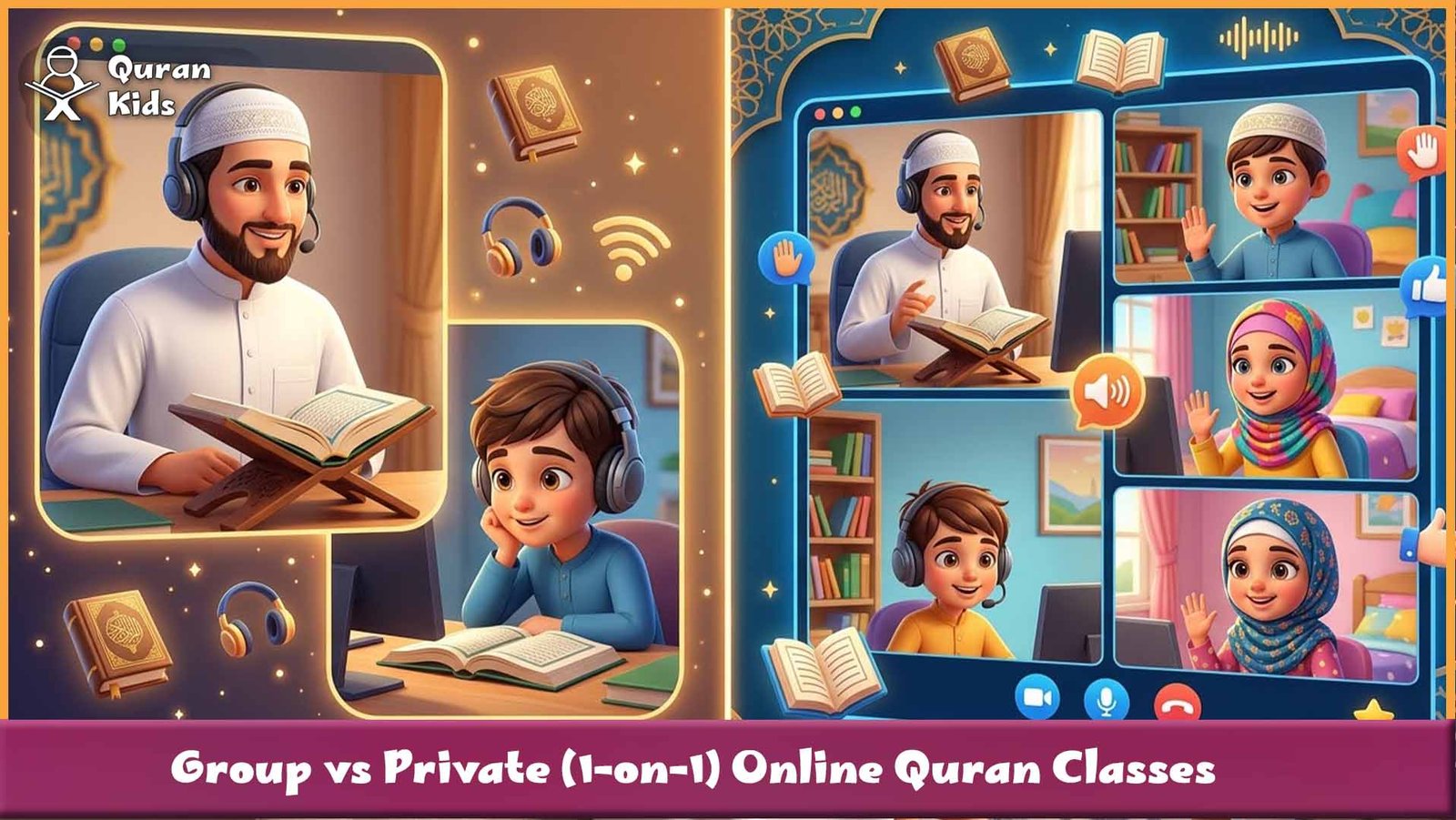
Group vs. Private (1-on-1) Online Quran Classes is an important comparison for parents who want their children to learn the Quran in a supportive, structured, and effective online environment.
Both learning formats can help students develop Quran reading skills, improve pronunciation, understand Tajweed, and build a consistent learning routine. However, they differ in teacher attention, lesson flexibility, classroom interaction, and the amount of individual feedback a learner receives.
Choosing the right format requires more than comparing class sizes. Parents should also consider their child’s age, current reading ability, confidence, attention span, and long-term goals. For example, a beginner who needs regular pronunciation correction may benefit from private instruction, whereas a confident learner may enjoy practising alongside classmates.
At Quran Kids Academy, families can consider their children’s learning needs when evaluating an appropriate Quran education format. Understanding the strengths and limitations of each option makes it easier to select a learning environment that supports steady progress without placing unnecessary pressure on the student.
This guide explains how individual and group Quran lessons work, compares their main features, and explores which format may suit different learners. It also provides practical questions to ask before enrolling so parents can make an informed decision.
Group vs Private Quran Classes: Which Is Better?

Before examining each format in detail, it helps to understand the main differences between private and group lessons. Although both can provide structured Quran education, the learning experience changes according to the number of students and how the teacher manages the session.
| Feature | Private Quran Classes | Group Quran Classes |
|---|---|---|
| Teacher attention | Focused on one learner | Shared among participants |
| Learning pace | Adjusted to individual needs | Generally follows a shared lesson plan |
| Pronunciation feedback | Can be immediate and specific | Depends on class size and lesson structure |
| Student interaction | Primarily between teacher and learner | Includes interaction with classmates |
| Scheduling | May offer greater flexibility | Often follows a fixed timetable |
| Learning environment | Individual and focused | Collaborative and social |
| Revision | Tailored to the learner’s needs | Usually follows a group revision plan |
| Cost structure | Generally higher per student | Often more affordable per student |
| Suitable learners | Beginners and students needing focused support | Learners who enjoy collaborative activities |
These differences provide a useful starting point, but they do not establish that one format is always superior. Instead, the quality of teaching, the teacher’s experience, the curriculum, and the student’s participation all influence the learning experience.
Start Learning Tafsir Classes Online Today
If you want to understand the Quran deeply with clear explanations and guided learning, now is the right time to begin your journey. Tafsir Classes Online at Quran Kids Academy provide structured lessons that simplify Quran meanings while helping students apply Islamic teachings in daily life.
In addition, experienced teachers support learners step by step to improve understanding, build confidence, and strengthen spiritual connection with the Quran. Users can also explore more related options.
Therefore, joining today can help you or your children gain authentic knowledge in a flexible and comfortable learning environment. Take the first step now and start building a stronger relationship with the Quran through guided tafsir education.

What Are Private (1-on-1) Online Quran Classes?
Private online Quran classes involve one student learning directly with a Quran teacher through a live online session. Because the teacher works with one learner at a time, the lesson can focus on that student’s reading ability, pronunciation challenges, and learning objectives.
For example, a child who struggles to distinguish between similar Arabic sounds may need additional listening and repetition exercises. Another student may already read Arabic comfortably but require help applying specific Tajweed rules. Individual instruction allows the teacher to address these differences without having to keep the entire class at the same pace. Private lessons may include:
- Learning Arabic letters and their correct sounds.
- Practising letter connections and Quranic words.
- Developing fluency through guided reading.
- Applying Tajweed rules during recitation.
- Reviewing previously learned passages.
- Preparing individual memorization and revision plans.
Moreover, teachers can adapt their explanations to the learner’s age and experience. Younger children may respond well to short activities and frequent encouragement, while older learners may prefer detailed explanations and independent practice.
At Quran Kids Academy, parents evaluating private lessons should ask how teachers assess students, identify recurring mistakes, and communicate progress. A clear learning plan can help families understand what their children are practising and which skills need further attention.
What Are Group Online Quran Classes?
Group online Quran classes bring several students together in a virtual classroom. A teacher leads the lesson, explains the topic, organizes reading practice, and provides feedback while managing the needs of multiple participants.
Depending on the program, students may be grouped according to age, Quran reading ability, Tajweed knowledge, or memorization goals. This organization matters because learners with broadly similar skills can usually participate in the same activities more comfortably. A typical group lesson may include:
- A brief review of the previous lesson.
- Explanation of a new Quran reading or Tajweed concept.
- Guided recitation practice.
- Listening activities involving classmates.
- Questions and answers.
- Homework or individual revision tasks.
One advantage of this format is that students can learn from the questions and mistakes of others. For instance, a learner may understand a pronunciation rule more clearly after hearing the teacher explain it to a classmate.
Nevertheless, the teacher must divide attention carefully. If several students need individual correction at the same time, each learner may receive less speaking practice than they would in a private lesson.
Therefore, parents should ask about group size, opportunities for individual recitation, and the way teachers correct mistakes. These details can make a substantial difference to the quality of group instruction.
Benefits of Private Online Quran Classes for Individual Progress
Private lessons can be useful when a student needs a learning plan that responds closely to individual strengths and difficulties. Instead of following a pace designed for several learners, the teacher can spend more time on the skills that require attention.
1. Personalized Learning Pace
Students do not master every Quran reading skill at the same speed. Some learn the Arabic alphabet quickly but need more practice connecting letters. Others recognize written words but struggle to pronounce certain sounds correctly.
With individual instruction, the teacher can adjust the lesson according to the student’s performance. Difficult topics can receive additional practice, while familiar material can be reviewed briefly before moving forward.
This approach may be particularly helpful for beginners who need time to build confidence. However, progress still depends on regular attendance, practice between sessions, and the suitability of the teaching method.
2. More Opportunities for Pronunciation Correction
Correct pronunciation is an important part of Quran learning. Students need to recognize Arabic letters, understand their articulation points, and practise the relevant sounds during recitation.
Private instruction gives the teacher more opportunities to listen closely to each student. When a mistake occurs, the teacher can demonstrate the correct sound, explain the difference, and ask the learner to repeat the word or passage.
Useful correction methods include:
- Listening to the learner read independently.
- Identifying repeated pronunciation mistakes.
- Demonstrating the correct articulation.
- Asking the learner to repeat the sound in context.
- Reviewing the same skill in later lessons.
Furthermore, a teacher can record recurring difficulties in a progress plan so that practice remains focused rather than repetitive without purpose.
3. Lessons Built Around Specific Goals
Not every student joins an online Quran program for the same reason. One child may need to learn basic reading, while another wants to improve fluency or begin memorizing selected surahs.
Private lessons can be structured around these different objectives. For example, a beginner may spend more time learning letter recognition, while a more advanced reader may focus on Tajweed application and correcting established habits.
At Quran Kids Academy, parents should discuss their child’s starting level and intended outcomes before choosing a program. This conversation can help establish whether individual lessons are appropriate and how progress will be reviewed.
4. Fewer Classroom Distractions
Some children find it difficult to concentrate when several students are speaking or participating in the same session. A private lesson can provide a quieter learning environment with fewer competing voices.
However, individual lessons still require attention and participation. Parents may need to prepare a suitable study space, check the internet connection, and help younger children join the session on time.
Consequently, private instruction can reduce certain distractions, but it does not automatically guarantee concentration or faster learning.
Benefits of Group Online Quran Classes for Social Learning
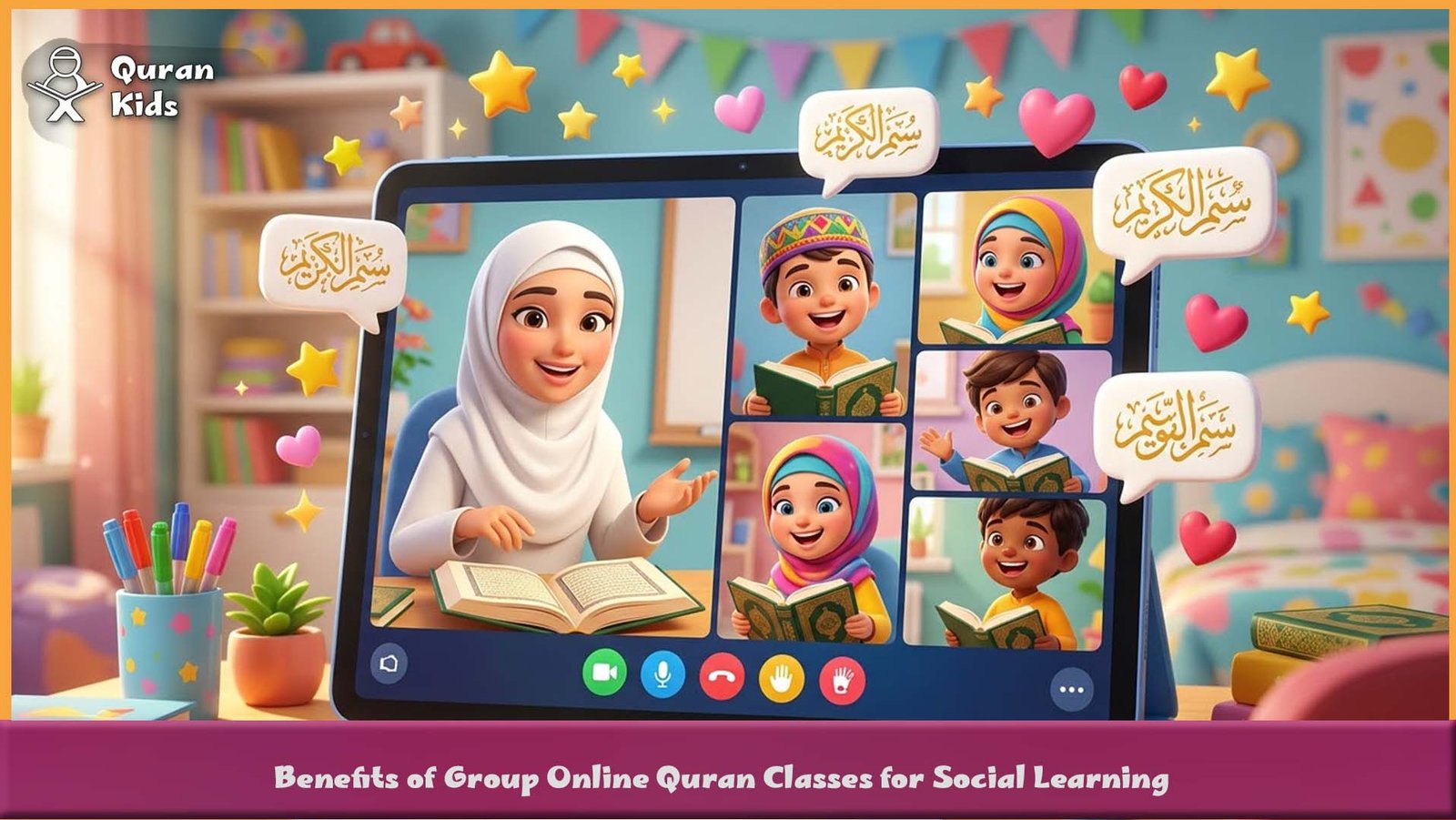
Group lessons offer a different experience. Rather than interacting only with a teacher, students share a learning environment with others who may have similar goals and abilities.
1. Learning Through Observation
Listening to classmates can expose students to different questions, reading challenges, and examples of how a teacher explains a concept.
For example, a student may hear another learner mispronounce a letter and then understand the teacher’s correction more clearly. This process can reinforce learning when the teacher gives everyone an opportunity to practise the correct sound.
Of course, observing others is not a replacement for personal feedback. Students still need to recite and receive correction themselves.
2. Encouragement Through Shared Participation
Some children feel more enthusiastic when they know other students are working toward similar goals. Group activities can create a sense of shared effort and encourage learners to participate regularly.
This environment may suit children who enjoy asking questions, listening to peers, and taking part in structured classroom activities.
At the same time, teachers should avoid turning Quran learning into an unhealthy competition. Each student has a different starting point, and progress should be measured against personal learning objectives rather than classmates’ achievements.
3. A Potentially More Affordable Format
Group classes generally distribute the teacher’s time across multiple students. As a result, the cost per learner may be lower than that of individual instruction, although actual fees depend on the provider, lesson duration, group size, and curriculum.
For families managing several educational commitments, this structure may make regular Quran lessons easier to fit into their budget.
Nevertheless, affordability should not be the only consideration. Parents should check whether students receive enough recitation practice, useful correction, and opportunities to ask questions.
4. Developing Classroom Participation Skills
Group sessions can help students practise listening, waiting for their turn, following instructions, and participating respectfully. These habits may be especially valuable for children who enjoy learning with peers.
Furthermore, a well-managed virtual classroom can introduce a predictable routine. Students learn when to listen, when to recite, and how to respond to feedback.
The effectiveness of this approach depends on appropriate class management. If students spend most of the lesson waiting for their turns, the educational benefits may be reduced.
Group vs Private (1-on-1) Online Quran Classes for Children
Parents often need to decide which format will help their children learn comfortably while developing accurate reading habits. The answer depends on the child’s developmental stage, existing skills, and response to different teaching environments.
When Private Classes May Suit Children Better
- Is learning the Arabic alphabet for the first time.
- Needs frequent pronunciation correction.
- Has difficulty concentrating in larger groups.
- Feels shy about reading aloud in front of others.
- Requires a lesson pace different from that of classmates.
- Needs a personalized plan for Quran reading or memorization.
For example, a young beginner may need repeated practice with a small set of letters before progressing to connected words. In a private session, the teacher can stay with that skill until the child demonstrates sufficient understanding.
Parents should also consider lesson length. A long session may be difficult for a young child to manage, regardless of class size. Shorter, age-appropriate activities and supportive feedback can make participation easier.
When Group Classes May Work Well for Children?
Group lessons may suit children who enjoy social interaction and can follow shared instructions. They can also be practical for siblings or friends who have comparable reading abilities and compatible schedules. A suitable group should provide:
- Clear classroom rules.
- Opportunities for every student to recite.
- Respectful correction without embarrassment.
- Activities appropriate to the children’s ages.
- A teacher who manages participation fairly.
Importantly, children should not be placed together solely because they are the same age. Their reading skills and learning needs also matter.
Before enrolling through Quran Kids Academy, parents can ask how children are assessed and grouped, how much time each student spends reciting, and how the teacher communicates concerns or progress.
Group vs Private Online Quran Classes for Adult Learners
Adults often approach Quran education with specific objectives. Some want to learn Arabic letters from the beginning, while others can read but want to improve pronunciation, apply Tajweed, or establish a consistent revision routine.
Private classes can be useful for adults who prefer a discreet learning environment or need a schedule that accommodates work and family responsibilities. They also allow the teacher to focus on personal difficulties without requiring the learner to follow a group pace.
Group classes, on the other hand, can appeal to adults who enjoy discussing learning challenges with others. A supportive group may help participants maintain motivation and recognize that other learners also encounter difficulties.
When choosing between these formats, adult learners should consider:
- Their current reading and Tajweed level.
- Whether they prefer individual or shared participation.
- The amount of feedback they need.
- Their availability during the week.
- Their comfort with reading aloud.
- Their short-term and long-term objectives.
Neither format is limited to a particular age group. The key is finding a teaching environment that makes regular practice realistic and encourages steady improvement.
Group vs Private Online Quran Classes for Tajweed and Recitation
Tajweed learning requires both understanding and practical application. Students may learn a rule in theory but still struggle to apply it consistently while reading a passage.
Private lessons offer more opportunities for a teacher to listen to an individual learner and address specific errors. This can be useful when a student needs help with articulation points, letter characteristics, elongation, or other recitation rules.
Group lessons can also support Tajweed learning when the teacher provides clear demonstrations and gives each participant sufficient time to practise. Listening to examples from classmates may reinforce the lesson, especially when the teacher explains why a particular pronunciation needs correction.
The most useful questions are not simply whether a class is private or shared, but whether the instruction includes:
- Accurate demonstrations of Tajweed rules.
- Regular individual recitation.
- Specific feedback on mistakes.
- Practice applying rules in Quranic passages.
- Revision of previously covered material.
- A way to monitor recurring difficulties.
Students with persistent errors may prefer private sessions initially. Later, they might join a group to practise in a collaborative setting, provided the class matches their ability.
Group vs Private Online Quran Classes for Quran Memorisation
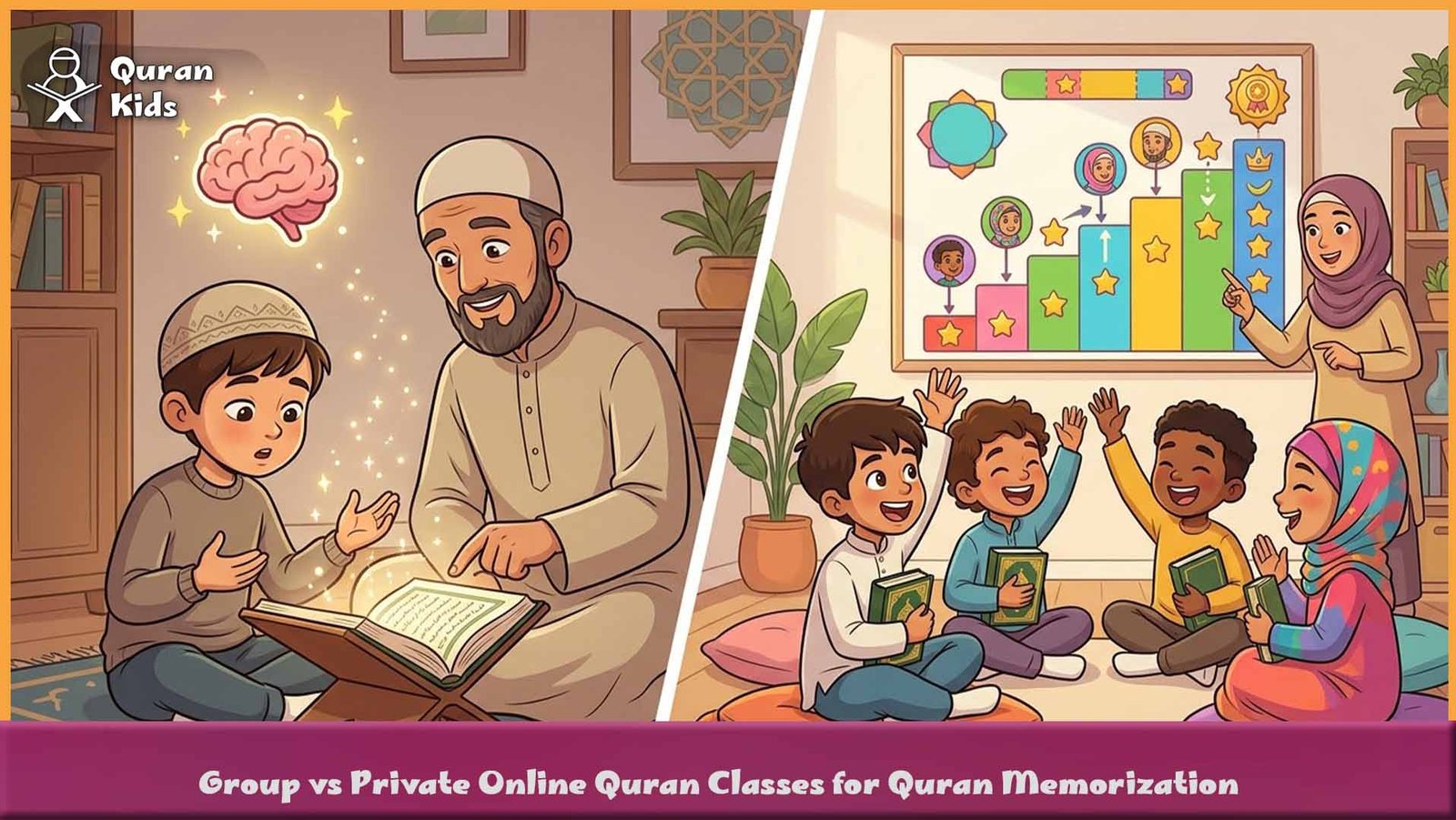
Quran memorisation, commonly known as Hifz, involves learning new passages and retaining previously memorized material. The process requires consistency, careful recitation, and a revision plan suited to the learner’s capacity.
Private instruction may help students who need individualised memorisation targets or frequent review. The teacher can identify weak passages, adjust the amount of new material, and organize revision around the student’s performance.
Group memorization classes can also be appropriate when participants have similar goals and the teacher organizes individual recitation effectively. Students may benefit from shared encouragement, provided each learner’s memorization is assessed rather than assumed to be correct. Before choosing a format, ask how the program manages:
- Daily or weekly memorization targets.
- Revision of previously learned passages.
- Correction of recitation mistakes.
- Assessment of retention over time.
- Adjustments when a student struggles.
- Communication with parents about progress.
Memorization should not be judged only by the amount completed in a short period. Accuracy, retention, and the ability to recite previously learned passages also matter.
At Quran Kids Academy, families considering Hifz instruction should discuss how individual performance will be monitored and how much revision is included in the learning plan.
How Class Size Affects Group vs Private Online Quran Classes?
Class size can influence how a lesson is organized, but it does not determine educational quality on its own. A small group with a clear curriculum and an attentive teacher may offer a positive learning experience. Conversely, a poorly organized private lesson may fail to address the student’s needs. The important issue is how effectively the teacher uses the available time.
In a group setting, parents should find out how many students attend each session and whether the teacher listens to every learner individually. A larger group may require a more structured rotation system so that no student is consistently overlooked.
For private lessons, parents should ask how the teacher balances explanation, practice, correction, and revision. Individual attention is valuable only when it is used to support meaningful learning.
Consider these indicators of a well-organized lesson:
- Students have clear learning objectives.
- The teacher checks understanding rather than simply delivering information.
- Pronunciation errors are corrected respectfully.
- Practice time is appropriate for the student’s level.
- Progress is reviewed at reasonable intervals.
- Parents know how to support practice between sessions.
Ultimately, teaching quality, learner participation, and consistent practice matter alongside class size.
Scheduling Group vs Private Online Quran Classes
A suitable learning format should fit naturally into the student’s weekly routine. Even a well-designed program may be difficult to maintain if lesson times repeatedly conflict with school, work, family responsibilities, or other commitments.
When comparing Group vs Private (1-on-1) Online Quran Classes, parents should consider not only scheduling flexibility but also the time their children need for practice and revision.
Private lessons may provide more scheduling flexibility, depending on the provider’s availability and policies. This can help families living in different time zones coordinate classes around their daily routines. Parents looking for the best online quran lessons for kids should also check whether lesson times allow children to stay focused without feeling tired after school.
Group classes often follow fixed timetables because several learners need to attend together. That structure can help students build a routine, but it may be less convenient when family schedules change frequently. Before enrolling, consider:
Whether the lesson time works throughout the school term.
How missed lessons are handled.
Whether rescheduling is permitted.
What happens when the teacher is unavailable.
Whether make-up sessions are offered.
How students can review material after an absence.
Policies differ between providers, so parents should confirm these details rather than assume every online program operates the same way. A realistic timetable is more useful than an ambitious schedule that the student cannot maintain. Regular attendance and manageable practice sessions can support progress over time.
How to Evaluate Teachers for Group vs Private Online Quran Classes?
The quality of instruction deserves as much attention as the choice between private and group classes. A suitable teacher should understand Quran reading, apply Tajweed accurately within their teaching scope, explain concepts clearly, and adapt feedback to the learner’s level.
Parents should also ask how the curriculum moves from one skill to another. For beginners, a structured progression may include letter recognition, pronunciation, connected words, reading fluency, and introductory Tajweed.
More advanced students may need targeted recitation correction or memorization support. Families can explore basic tajweed rules for kids to understand some of the foundational concepts children may practise during lessons. Use the following checklist when comparing programs:
Teaching experience: Ask about the teacher’s background and experience with children or adult learners.
Curriculum: Find out what students learn at each stage.
Assessment: Ask how the starting level is determined.
Feedback: Check how pronunciation mistakes are identified and corrected.
Communication: Clarify how parents can discuss progress or concerns.
Technology: Confirm that the platform supports clear audio and stable communication.
Learning objectives: Ask how goals are established and reviewed.
At Quran Kids Academy, families can use these questions to understand whether the teaching approach matches their children’s current abilities and learning goals. Clear answers make it easier to compare programs on educational value rather than relying on promotional claims.
Questions to Ask Before Choosing Group vs Private Online Quran Classes
A trial lesson or introductory conversation can help families understand how an online Quran program operates. Instead of focusing only on the class format, parents should ask questions that reveal what the student will actually experience. When evaluating Group vs Private (1-on-1) Online Quran Classes, they should also determine whether the curriculum starts at the child’s current level or assumes previous Quran reading experience. Useful questions include:
How do you assess a new student’s reading level?
How much time does each learner spend reciting?
How are pronunciation mistakes corrected?
Can the curriculum be adjusted when a student struggles?
How do you communicate progress to parents?
What materials or books should students prepare?
Are there policies for missed lessons and rescheduling?
Can a student change formats if their needs evolve?
Parents should also observe the child’s response after a trial session. Did the student understand the instructions? Was the teacher patient and clear? Did the lesson match the child’s level? Could the child explain what they learned?
These observations provide useful evidence for making a decision. Parents can also review resources that explain how children learn the quran basics to better understand the foundational skills a suitable program should address.
Common Mistakes When Choosing Group vs Private Online Quran Classes
Parents can avoid unnecessary difficulties by looking beyond broad claims about private and group learning. Several common mistakes may lead to a poor match between the student and the program.
Choosing Only by Price
Affordability matters, particularly for families planning long-term lessons. However, the lowest fee does not necessarily represent the best value if students receive limited practice or unclear feedback.
Compare class duration, teacher attention, curriculum, and revision support before deciding.
Assuming Every Child Needs Private Lessons
Some children thrive in individual sessions, while others become more engaged when learning alongside peers. The decision should reflect the child’s needs rather than a general belief that one format is always better.
Ignoring the Teacher’s Feedback Method
A class may cover many topics without helping students correct persistent mistakes. Ask how teachers identify errors, explain corrections, and check whether students can apply the guidance independently. For families who prefer a female instructor, it may also be useful to review the female online quran teacher for kids option and ask about teacher availability and suitability for the child’s learning needs.
Overlooking the Student’s Preferences
Children are more likely to participate when the learning environment feels supportive. Parents should listen to their child’s concerns while also considering educational needs and practical constraints.
Expecting Immediate Results
Quran reading, Tajweed, and memorization develop through practice and review. A class format can support learning, but progress varies according to starting ability, attendance, practice, and teaching quality.
A thoughtful enrollment decision focuses on sustainable learning rather than promises of unusually rapid results.
Can Students Switch Between Group and Private Online Quran Classes?
In some programs, students can move from group lessons to private instruction or the other way around. However, this depends on the provider’s available schedules, enrollment policies, and teaching arrangements.
A learner might begin with private classes to establish basic reading skills and later join a group when comfortable reading aloud. Another student may start in a group but prefer individual instruction when preparing for a specific memorization goal. For children working toward memorization, parents can also explore guidance on how to hifz quran online to understand the importance of regular revision and an appropriate learning plan.
Changing formats can be useful when learning needs evolve. For example, a child who once benefited from close guidance may later become confident enough to participate in a shared classroom. Conversely, a student who needs more detailed correction may benefit from temporarily returning to private sessions.
Before enrolling, ask whether you can change formats, whether a new assessment is required, and how the curriculum will continue after the change.
At Quran Kids Academy, parents should confirm the available learning arrangements directly rather than assuming that every format or transfer option is offered.
Choosing Group vs Private Quran Classes at Quran Kids Academy
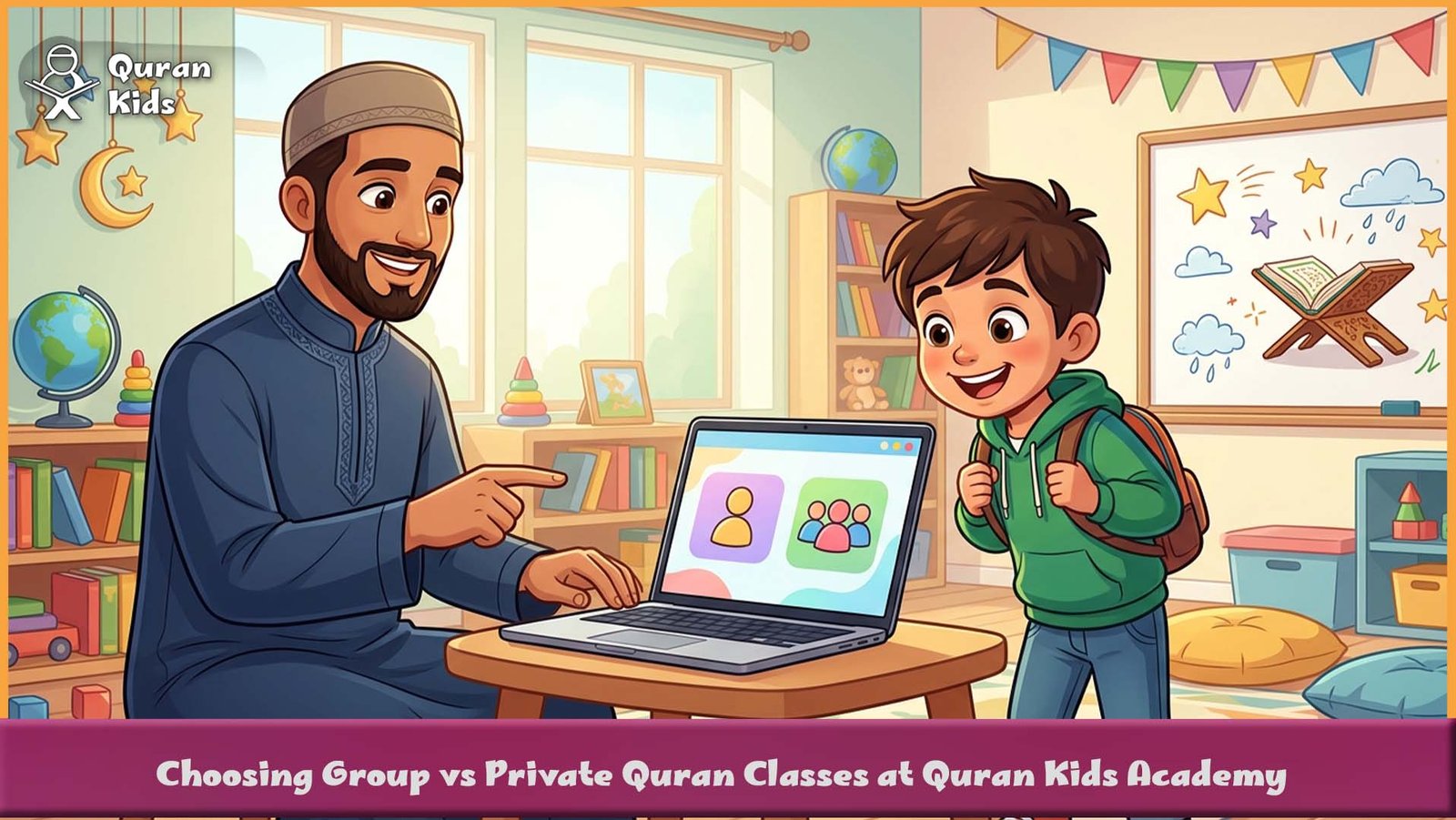
Choosing an online Quran program begins with understanding the student’s needs. Some learners need help with Arabic letters and basic reading, while others want to improve recitation, practise Tajweed, or develop a more consistent memorisation routine.
Quran Kids Academy can be the starting point for families exploring an appropriate Quran learning arrangement. Before selecting a class, parents should discuss the child’s current ability, learning objectives, preferred schedule, and the type of feedback that would be most useful. When evaluating a program, families should look for:
- A clear process for assessing the learner’s starting level.
- Learning objectives that match the student’s ability.
- Qualified teachers who explain and correct respectfully.
- Opportunities to practise recitation.
- A reasonable plan for revision and progress monitoring.
- Clear information about scheduling and class policies.
These details help parents decide whether private or group instruction is a suitable option. They also provide a basis for discussing any concerns before lessons begin.
Rather than choosing a format based only on popularity, families should consider the student’s actual experience during an introductory lesson, where available. The goal is to find an educational environment that supports consistent participation and meaningful Quran learning.
Frequently Asked Questions About Group vs Private (1-on-1) Online Quran Classes
Help parents compare both learning formats and choose the best option for their child’s Quran education.
1. What internet connection and equipment does a student need for online Quran lessons?
Students generally need a stable internet connection, a device with a working microphone and speakers or headphones, and a quiet place to study. A camera may also be required, depending on the program’s teaching arrangements. Parents should test the audio before the first lesson because clear sound is particularly important for listening to Arabic pronunciation and receiving recitation feedback.
2. Should parents sit with their children during online Quran classes?
The answer depends on the child’s age, independence, and comfort with technology. Younger children may need a parent nearby to help them join the session, manage materials, or stay focused. As children become more independent, parents can gradually reduce direct supervision while continuing to check attendance, practice, and progress.
3. How can parents help children practise Quran reading between lessons?
Parents can establish a short, consistent practice routine based on the teacher’s instructions. Children may review previously learned letters or passages, listen carefully to assigned examples, and repeat the material without rushing. If a child is unsure about a pronunciation rule, parents should avoid reinforcing a guess and instead ask the teacher for clarification.
4. What should families do if a child feels anxious about making mistakes during recitation?
Parents should reassure the child that mistakes are a normal part of learning and do not need to cause embarrassment. They can discuss the concern with the teacher and ask for gentle correction, manageable practice tasks, and opportunities to build confidence gradually. If the anxiety continues, reviewing the class environment and teaching approach may help identify a more comfortable learning arrangement.
In conclusion, choosing between group and private (1-on-1) online Quran classes depends on your child’s learning needs, personality, and goals. Group classes can encourage interaction, shared practice, and learning alongside other children. Private lessons, however, provide more individual attention, allowing the teacher to focus on your child’s recitation, pronunciation, and Tajweed progress.
Before making a decision, consider your child’s current Quran reading level, ability to concentrate, and comfort with participating in a group. Also, think about whether your child needs personalized correction or benefits from learning with peers.
At Quran Kids Academy, parents can explore the learning format that best supports their child’s Quran education. The right choice is not necessarily the same for every family; it is the one that helps your child learn consistently, build confidence, and develop accurate recitation skills.
Ultimately, regular practice, qualified guidance, and a suitable learning environment matter more than the class format alone.