Fixing Pronunciation Errors in Noorani Qaida: Simple Tips
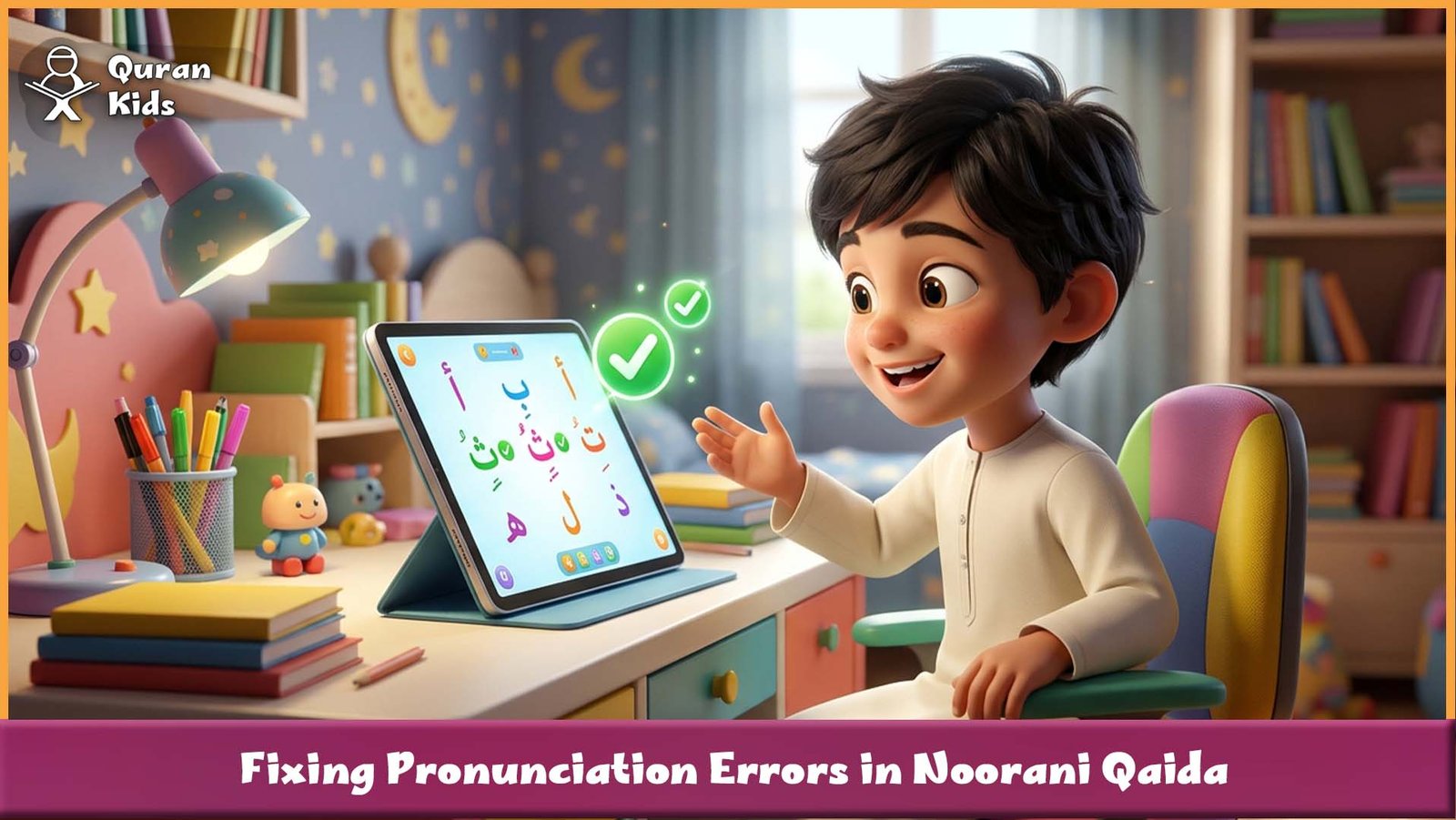
Fixing pronunciation errors in noorani qaida helps children and beginners develop accurate Arabic reading skills before progressing to Quran recitation. Learning the Arabic alphabet is only the first step.
Students must also recognize the correct articulation points, distinguish between similar letters, pronounce vowel marks accurately, and connect letters without changing their sounds.
For Muslim families in the United States, the United Kingdom, and Canada, teaching children Arabic pronunciation can be challenging when Arabic is not spoken regularly at home. However, identifying common mistakes and following structured exercises can help children improve gradually.
This guide explains seven frequent pronunciation errors, practical ways to correct them, and how parents can support their children’s Quran learning at home.
Why Is Correct Pronunciation Important in Noorani Qaida?
Noorani Qaida introduces beginners to Arabic letters, vowel marks, Sukoon, Tanween, and basic letter combinations. These skills prepare students to read Quranic words more accurately.Correct pronunciation is important because:
- Letter recognition: Students learn to distinguish between Arabic letters that have similar sounds.
- Accurate reading: Correct articulation helps prevent pronunciation mistakes from becoming repeated habits.
- Tajweed preparation: A strong foundation makes it easier to understand and apply Tajweed rules.
- Reading confidence: Children become more comfortable reading aloud when they recognize the sounds of individual letters.
For example, confusing س (Seen) with ص (Saad) is not simply a difference in accent. These letters have different articulation characteristics, and students need to learn how to produce each sound correctly.
7 Common Pronunciation Errors in Noorani Qaida
Understanding the source of a pronunciation mistake makes correction easier. The following errors frequently occur among beginners.
1. Confusing Similar Arabic Letters
Some Arabic letters have similar sounds, making them difficult for children who are unfamiliar with Arabic.Common examples include:
- س and ص
- ت and ط
- ذ and ز
- ح and ه
- ق and ك
The best approach is to teach each letter separately before comparing it with a similar sound. Children should listen, observe the teacher’s articulation, and repeat both letters in short exercises.
2. Mispronouncing Throat Letters
Arabic contains several letters produced from different areas of the throat, including ء، ه، ع، ح، غ، and خ.
Beginners may replace unfamiliar throat sounds with easier sounds from their native language. This is particularly common among children growing up in English-speaking households.
Teachers should demonstrate each articulation point and allow students to practice slowly. For example, ع and ح require different articulation techniques, so simply repeating them quickly is unlikely to solve the problem.
3. Confusing Short Vowels
Fatha, Kasra, and Damma represent three different short vowel sounds.
| Vowel | Example | Basic sound |
|---|---|---|
| Fatha | بَ | Short a |
| Kasra | بِ | Short i |
| Damma | بُ | Short u |
A practical exercise is to ask children to read these three examples in sequence while keeping the consonant unchanged. This helps them notice how the vowel mark changes the sound.
4. Mixing Up Short and Long Vowels
Students sometimes pronounce short vowels for too long or fail to extend long vowels correctly.For example:
- بَ contains a short vowel.
- بَا contains a long vowel.
Parents can help by asking children to listen to both examples and identify the difference in duration. The goal is to understand the distinction without exaggerating vowel length.
5. Adding Extra Sounds to Letters with Sukoon
A common beginner mistake is adding an unnecessary vowel after a letter carrying Sukoon.For example, a child may struggle to pronounce بْ without adding an extra sound.
Practice short combinations such as أَبْ، أَتْ، and أَكْ. Begin slowly, then gradually increase reading fluency without sacrificing accuracy.
6. Using Incorrect Articulation Points
Arabic letters have specific articulation points known as Makharij Al-Huroof. These involve different positions of the tongue, lips, and throat.
A student may recognize a letter correctly but pronounce it incorrectly because the sound comes from the wrong place.
Teachers should explain the relevant articulation point and demonstrate how the sound is produced. This is more effective than asking children to repeat a letter without understanding the source of the mistake.
7. Rushing Through Reading Exercises
Some children focus on completing lessons quickly instead of producing each sound correctly.This can create repeated mistakes when connecting letters or reading unfamiliar combinations.
Encourage children to read slowly, pause when necessary, and repeat difficult examples. Accuracy should come before speed.
8 Practical Methods for Fixing Pronunciation Errors in Noorani Qaida
Correcting pronunciation requires consistent practice, clear demonstrations, and appropriate feedback. These eight methods can make learning more effective.
1. Listen to the Correct Pronunciation
Children should hear a letter pronounced correctly before attempting to reproduce it. Listening helps them recognize unfamiliar sounds and compare similar letters.
2. Practice One Difficult Letter at a Time
Avoid introducing several challenging letters in one session. Choose one or two sounds and practice them until the child becomes more comfortable.
For example, focus on ح before introducing exercises that compare ح and ه.
3. Use the Listen-and-Repeat Method
This technique allows children to compare their pronunciation with the teacher’s demonstration.A simple exercise involves five steps:
- The teacher pronounces a letter or combination.
- The child listens carefully.
- The child repeats the sound.
- The teacher identifies the specific mistake.
- The child repeats the example with guidance.
This structured approach makes fixing pronunciation errors in noorani qaida more manageable.
4. Compare Similar Letters in Short Exercises
Instead of practicing letters randomly, organize them into small comparison exercises.
For example, ask the student to pronounce س and ص separately, then identify the difference. The teacher can repeat the demonstration whenever the distinction becomes unclear.
5. Record and Review Recitation
Recording a child’s reading can help parents and teachers identify recurring mistakes. Listening again also allows students to become more aware of their pronunciation.
However, recordings should complement direct instruction rather than replace feedback from a knowledgeable teacher.
6. Practice Short Daily Sessions
Ten to fifteen minutes of focused practice can help children maintain consistency. Choose a quiet time when they can concentrate without feeling rushed.
7. Review Previous Lessons
Before introducing new letters or combinations, revisit previously learned material. Regular revision helps prevent students from forgetting correct pronunciation.
8. Request Individual Correction
Children do not all experience the same pronunciation difficulties. Some struggle with throat letters, while others need more practice with vowel marks or connected sounds.
Individual instruction allows the teacher to identify specific weaknesses and select suitable exercises.
Practical Exercises to Correct Arabic Pronunciation
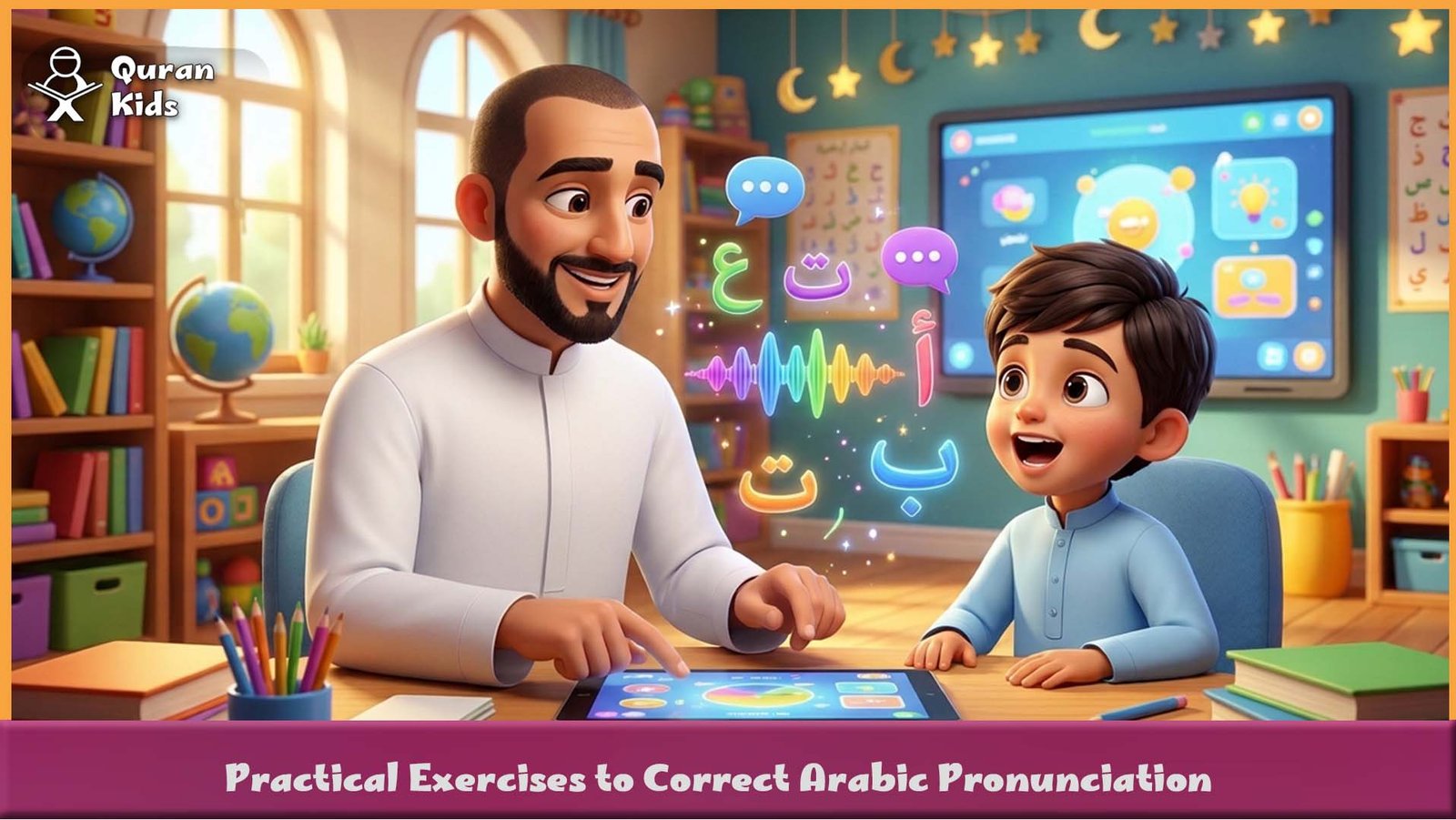
Parents and teachers can use the following exercises to make practice more focused.
| Pronunciation difficulty | Suggested exercise | Learning objective |
|---|---|---|
| س and ص | Listen and repeat both letters | Recognize different articulation |
| ح and ه | Practice each sound separately | Improve throat articulation |
| بَ، بِ، بُ | Change one vowel at a time | Recognize short vowels |
| بَ and بَا | Compare vowel duration | Distinguish short and long vowels |
| أَبْ and أَتْ | Read slowly with Sukoon | Avoid adding unnecessary vowels |
| ق and ك | Practice under teacher guidance | Recognize different articulation points |
Start with isolated letters, then gradually introduce syllables and connected examples. However, children should not move to more difficult exercises simply because they can repeat an example once. Instead, consistent accuracy should be the main indication of progress.
How Can Parents Help Children Improve Quran Pronunciation at Home?
Parents play an important role in supporting Quran education, even when they do not speak Arabic fluently. To help children improve their pronunciation, parents can follow these practical steps:
- First, establish a regular time for Quran reading.
- In addition, encourage children to pronounce letters slowly.
- Meanwhile, listen to their practice and identify recurring difficulties.
- Also, avoid criticizing mistakes harshly.
- Instead, celebrate small improvements.
- Finally, communicate with the teacher about sounds that remain difficult.
For families exploring different learning options, it is also useful to understand the differences between online Quran classes vs. traditional madrasa. This comparison can help parents understand how different educational environments support children’s learning.
Similarly, parents may compare online Quran classes vs. mosque classes to determine which arrangement better fits their family’s schedule and educational needs.
For Muslim families in Australia and New Zealand, online learning may provide additional flexibility, especially when local Quran learning options or suitable lesson times are limited.
How Online Quran Lessons Support Better Pronunciation
Live online Quran instruction can help children receive direct feedback while practicing Arabic letters and Quran reading. For example, during a lesson, a teacher can:
- First, listen to the child’s recitation.
- Then, identify incorrect letter pronunciation.
- Next, demonstrate the correct articulation.
- After that, ask the student to repeat difficult sounds.
- Finally, review previous exercises and recurring mistakes.
Moreover, parents can compare online Quran classes vs. Quran apps and live Quran tutor vs. Quran learning software to understand why direct pronunciation feedback can be important. They can also explore Group vs Private (1-on-1) Online Quran Classes to identify a suitable learning arrangement.
Quran Kids Academy is another option worth exploring for children’s Quran education. However, parents should confirm the available courses and teaching arrangements before enrolling. They should also consider their child’s needs and local time zone in the United States, United Kingdom, or Canada.
Common Mistakes to Avoid When Correcting Children’s Pronunciation
Parents sometimes unintentionally make pronunciation practice more difficult by focusing on speed instead of accuracy. Therefore, they should avoid the following common mistakes:
- Correcting too many sounds at once: Instead, focus on one important mistake before introducing another.
- Comparing children: Remember that each learner develops pronunciation skills at a different pace.
- Moving forward too quickly: Therefore, make sure the child understands the current lesson before progressing.
- Ignoring repeated mistakes: These errors need additional attention and practice.
- Practicing without feedback: As a result, repetition alone may reinforce incorrect pronunciation.
Ultimately, patience and clear instruction help children develop better reading habits without unnecessary pressure.
Frequently Asked Questions
Explore these frequently asked questions to find clear answers about correcting pronunciation and helping children improve their Quran reading skills.
1. At What Age Should Children Start Learning Noorani Qaida?
Children can generally begin when they have sufficient attention and listening skills to recognize letters and follow simple instructions. However, readiness varies, so parents should consider each child’s individual development.
2. How Long Does It Take to Correct Arabic Pronunciation Mistakes?
The time depends on the child’s starting level, the type of mistake, practice frequency, and quality of instruction. For example, some sounds require more repetition and guidance than others.
3. Can Children Learn Correct Arabic Pronunciation Without Speaking Arabic?
Yes. Children do not need to speak Arabic fluently to learn Quran reading. Nevertheless, they need clear demonstrations, regular listening practice, and feedback to develop accurate pronunciation.
Conclusion
Fixing pronunciation errors in noorani qaida requires patience, consistent practice, and appropriate guidance. By recognizing common mistakes, understanding articulation points, practicing vowel marks, and reviewing previous lessons, children can gradually develop stronger Quran reading foundations.
Therefore, parents who want to explore online Quran education for their children can contact Quran Kids Academy to ask about its available learning options and determine whether its programs suit their children’s needs. With a supportive learning environment and regular pronunciation practice, young learners can gradually become more confident Quran readers.