
Online Quran Classes vs Mosque Classes: Main Differences
Online Quran classes vs. mosque classes is an important comparison for parents, children, and adults who are keen to learn the Quran in an environment that supports accurate recitation, regular practice, and long-term progress. Both learning methods offer valuable benefits. However, they differ in scheduling, teacher access, personal attention, community involvement, and convenience.
Mosque Quran classes provide face-to-face interaction and an opportunity to learn alongside other Muslims. In contrast, online lessons allow students to study from home, communicate with teachers remotely, and choose schedules that fit their daily responsibilities.
Therefore, the right choice depends on several factors, including the learner’s age, current Quran reading level, learning goals, available teachers, and preferred learning environment.
Some children feel more comfortable learning in a mosque with their friends. Others make better progress when they receive individual attention during an online lesson. Similarly, adults with busy schedules may appreciate the flexibility of remote learning, while others prefer attending a mosque regularly.
This guide explains the main differences between online and mosque Quran classes, helping families evaluate both options and select an approach that supports accurate learning and consistent improvement.
How Online and Mosque-Based Quran Education Differ?

Online Quran classes may be more suitable for students who need flexible schedules, individual attention, convenient access to teachers, or lessons from home.
On the other hand, mosque classes may suit learners who value face-to-face communication, local Muslim communities, group activities, and a regular learning routine. Consider these differences before deciding:
- Choose online learning if flexibility, personal correction, and access to different teachers are important.
- Choose mosque learning if community involvement, in-person interaction, and group motivation are priorities.
- Choose a combination if the student wants individual Quran instruction alongside community participation.
Ultimately, the best option is not determined by the location of the lesson. Instead, teacher qualifications, correction quality, student participation, and consistent revision have a greater influence on learning outcomes.
Start Learning Tafsir Classes Online Today
If you want to understand the Quran deeply with clear explanations and guided learning, now is the right time to begin your journey. Tafsir Classes Online at Quran Kids Academy provide structured lessons that simplify Quran meanings while helping students apply Islamic teachings in daily life.
In addition, experienced teachers support learners step by step to improve understanding, build confidence, and strengthen spiritual connection with the Quran. Users can also explore more related options.
Therefore, joining today can help you or your children gain authentic knowledge in a flexible and comfortable learning environment. Take the first step now and start building a stronger relationship with the Quran through guided tafsir education.

Where Online Quran Classes vs Mosque Classes Fit in Your Learning Journey?
Understanding the differences between learning formats is one step toward building a successful Quran education plan.
Before selecting a class, students should identify what they want to achieve. For example, beginners may need help recognizing Arabic letters, connecting words, and developing accurate pronunciation. Meanwhile, advanced learners may require more focused Tajweed instruction, memorization support, or recitation correction. Families can explore several related learning topics:
- Learn Quran Online: A Step-by-Step Guide for Every Level.
- What Is the Best Way to Learn Quran Online?
- Private vs Group Quran Classes: Which Is Better?
- Learn Quran Reading Online with a Teacher.
- Learn Quran Online for Kids: A Parent’s Guide.
Each topic addresses a different part of the learning process. However, this comparison focuses on selecting the learning environment that best supports the student’s needs.
Online Quran Classes vs Mosque Classes: The Main Differences
Although both methods aim to help Muslims read and learn the Quran, their teaching environments create different experiences.
Online education takes place through digital platforms, usually with a teacher and student communicating through live video lessons. Depending on the program, students may receive individual instruction or participate in small groups.
Mosque education generally takes place in a physical classroom or designated learning area inside the mosque.
Students attend scheduled sessions and interact directly with their teachers and classmates. The following table highlights the main differences.
| Comparison Factor | Online Quran Classes | Mosque Quran Classes |
|---|---|---|
| Schedule | Often more flexible | Usually fixed |
| Learning location | Home or another suitable place | Mosque premises |
| Teacher selection | May include teachers from different locations | Usually local teachers |
| Personal attention | Available through individual lessons | Depends on class size |
| Social interaction | Depends on lesson format | Direct interaction |
| Travel | Not required | Usually necessary |
| Parent supervision | Easier to arrange at home | Depends on the setting |
| Peer motivation | Depends on group activities | Often part of the classroom |
| Learning resources | Digital materials may be available | Usually depends on the teacher |
| Progress monitoring | Depends on the provider | Depends on the class system |
Nevertheless, these differences do not mean that one format always produces better results. A well-organized mosque program may provide excellent instruction, while a poorly managed online class may fail to meet the student’s needs.
Likewise, a structured online lesson can offer better individual correction than an overcrowded local class.
When Are Online Quran Classes Better for Students?
Online learning can be a practical option for families and individuals who need greater control over their learning arrangements.
For instance, parents who manage school schedules, extracurricular activities, and family responsibilities may find it difficult to attend a mosque at a fixed time every day.
In such situations, remote lessons can make Quran education easier to organize. Online classes may be especially helpful when:
- The family has a busy daily routine.
- The nearest mosque does not offer suitable Quran lessons.
- The student needs individual pronunciation correction.
- The child feels uncomfortable speaking in a large group.
- An adult prefers studying in a private environment.
- The learner wants to focus on Tajweed or Quran memorization.
- Parents need greater control over lesson timing.
- The student requires a teacher who understands their current reading level.
Furthermore, online learning can reduce the time spent traveling to and from lessons. This may help students maintain a more consistent schedule, particularly when local classes are difficult to reach.
However, convenience should not be the only consideration. Parents should also check the teacher’s qualifications, lesson structure, communication methods, and approach to correcting mistakes.
For families comparing different teaching arrangements, the article Online Quran Academy vs Private Tutor explains the differences between structured learning programs and individual tutoring.
When Are Mosque Quran Classes a Better Choice?
Mosque classes offer an in-person environment that can support social interaction and a sense of belonging.
For many children, attending lessons with other Muslim students creates a regular connection between Quran education and community life.
Moreover, face-to-face learning allows students to communicate directly with their teachers, observe classroom demonstrations, and participate in group activities. Mosque classes may be a suitable choice when:
- A qualified Quran teacher is available nearby.
- The learning environment is organized and welcoming.
- Students are divided according to their reading abilities.
- The child enjoys learning alongside other children.
- Parents value regular interaction with the local Muslim community.
- The class schedule fits the family’s routine.
- The student feels motivated by attending lessons in person.
Another advantage is the opportunity to develop friendships with other learners who share similar educational goals.
Nevertheless, parents should not assume that every mosque class provides the same level of instruction. Class size, teacher experience, lesson duration, and opportunities for individual recitation all deserve attention.
Online Quran Classes vs Mosque Classes: Why Teacher Correction Matters
Regardless of the learning environment, accurate Quran instruction requires regular feedback from a qualified teacher.
Students may develop pronunciation mistakes when they practice without receiving appropriate correction. Consequently, listening carefully and identifying errors are essential parts of the learning process.
For example, a beginner may confuse Arabic letters that have similar sounds. Another learner may pronounce a letter correctly in isolation but struggle when reading it within a Quranic word.
A teacher should identify these difficulties and provide clear explanations and practical exercises.
What Should Teachers Check During Quran Lessons?
Parents and students can use the following checklist when evaluating a learning program.
| Question | Why It Matters |
|---|---|
| Does every student get an opportunity to recite? | Encourages active participation |
| Does the teacher correct pronunciation mistakes? | Supports accurate reading |
| Are students grouped by ability? | Helps match lessons to their level |
| Is Tajweed explained appropriately? | Develops correct recitation |
| Is progress reviewed regularly? | Identifies areas needing improvement |
| Are home revision tasks provided? | Encourages consistent practice |
Importantly, personal attention is not guaranteed simply because a lesson takes place online. Similarly, attending a mosque does not automatically mean that every student receives sufficient correction. The quality of instruction should remain the priority in either setting.
Online Quran Classes vs Mosque Classes for Children
Choosing the right learning environment for children requires additional consideration because young learners have different attention spans, communication styles, and educational needs.
Some children enjoy learning in groups because they can interact with friends and participate in shared activities. Others may feel distracted or hesitant when they have to recite in front of several classmates.
Online instruction can provide a quieter learning environment, particularly when lessons are arranged according to the child’s level.
However, successful online learning for children also requires parental involvement and appropriate supervision.
Benefits of Online Quran Learning for Kids
- Children can study in a familiar home environment.
- Parents can observe parts of the learning process.
- Individual lessons may provide more opportunities to practice.
- Lesson times can be arranged around school responsibilities.
- Teachers can focus on specific pronunciation difficulties.
- Students can receive instruction without traveling.
Nevertheless, parents should consider whether their child can concentrate during video lessons. Younger children may need shorter sessions, breaks, and interactive teaching methods.
Benefits of Mosque Quran Classes for Kids
Mosque classes can also support children’s development in several ways. First, children can meet other Muslim learners and develop friendships. Additionally, regular attendance may help them build a routine around Quran education.
Group recitation can also encourage participation, although teachers must ensure that every child receives enough individual attention.
Parents should evaluate the classroom environment, teacher-to-student ratio, cleanliness, supervision, and organization before enrolling their children.
For additional guidance, parents can explore Best Online Quran Classes for Kids to understand the factors involved in choosing an appropriate learning program.
Online safety deserves equal attention. Families should establish clear supervision rules, protect personal information, use suitable communication settings, and understand how to report inappropriate behavior. The NSPCC online safety guidance offers useful information about protecting children in digital environments.
Online Quran Classes vs Mosque Classes for Hifz and Memorization
Quran memorization requires more than attending lessons regularly. Students need a structured approach that balances new memorization with revision.
Both online and mosque classes can support Hifz when the teacher follows a suitable learning plan.
However, the effectiveness of either format depends on how frequently the student recites, receives correction, and reviews previously memorized portions. A teacher should monitor:
- Newly memorized verses.
- Recent memorization.
- Older portions requiring revision.
- Pronunciation and Tajweed mistakes.
- The student’s ability to recite without prompts.
- Retention over an extended period.
For example, a child may memorize several new verses during a lesson but struggle to recall them the following week.
In this situation, adding more verses without addressing revision may create further difficulties. Therefore, the teacher should balance new material with regular review.
Families can also read the Complete Guide to Quran Memorization for Kids to understand the importance of revision, retention, and teacher feedback.
The learning environment is important, but a consistent memorization and revision system should guide the decision.
Cost and Time: Comparing Online and Mosque Quran Classes
The financial aspect is another important consideration for families. Parents who want quality Quran education without exceeding their budget can explore Affordable Online Quran Classes for Kids to understand the available learning options and compare their costs.
However, comparing lesson prices alone may not provide an accurate picture of the overall value of a Quran learning program.
Parents should consider additional expenses and practical commitments, including transportation, lesson duration, available teaching hours, and the time required to maintain attendance.
| Factor | Online Learning | Mosque Learning |
|---|---|---|
| Transportation | Usually unnecessary | May be required |
| Lesson fees | Vary by provider | May be free, community-based, or paid |
| Scheduling | Often flexible | Generally fixed |
| Teacher availability | May offer wider choices | Depends on local availability |
| Parent involvement | Can be arranged at home | Depends on the class |
| Community interaction | Depends on the program | Usually more direct |
For example, a mosque class may have a low enrollment fee, but transportation costs and travel time can increase the family’s overall commitment.
On the other hand, an online program may charge for lessons, but the family saves time by studying from home.
Therefore, parents should compare the total cost with the quality of teaching, the amount of individual attention, and the student’s actual progress.
How Quran Kids Academy Can Help Students Explore Online Quran Learning?
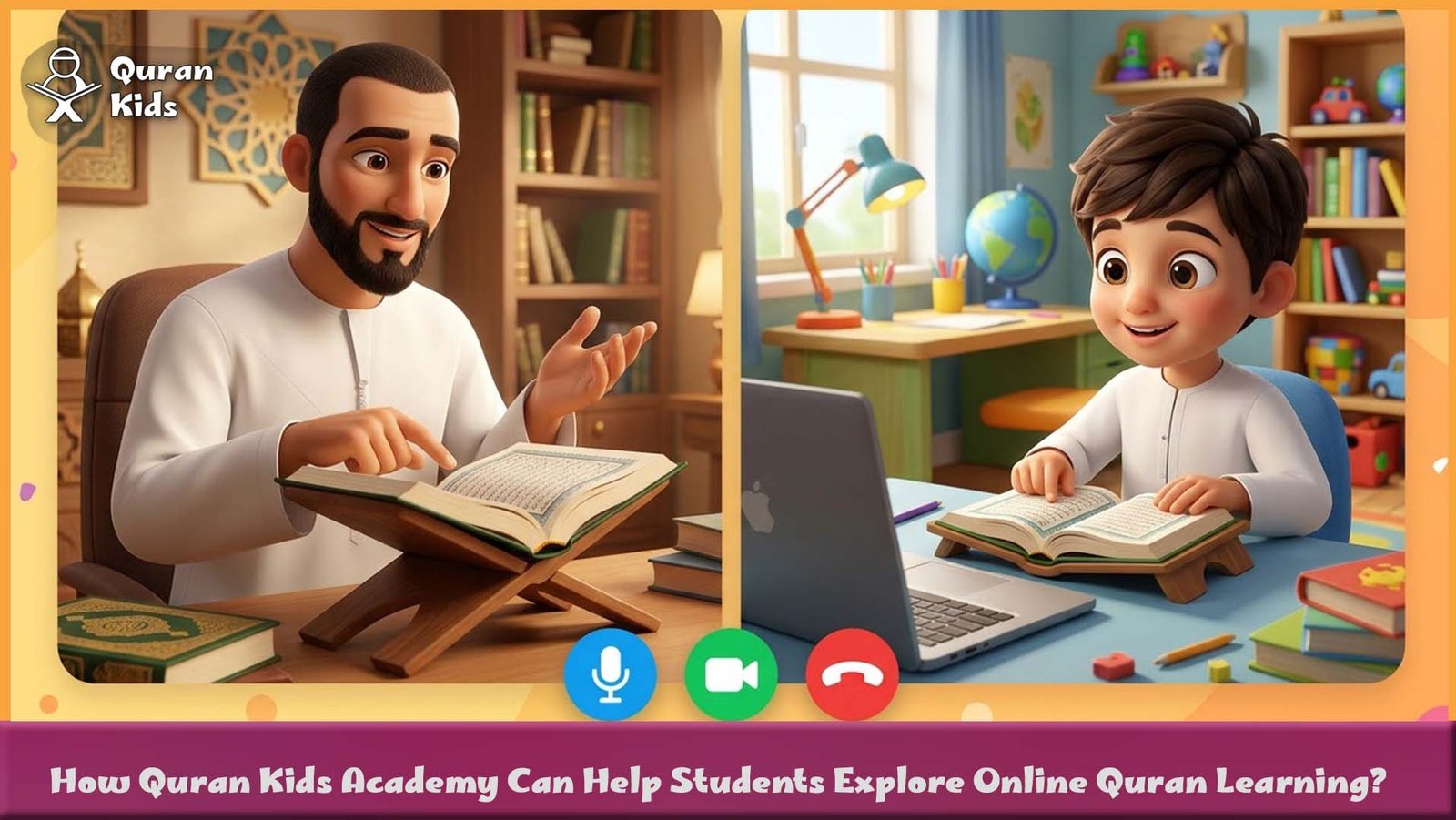
After understanding the differences between online and mosque education, families may want to explore whether a structured online learning option matches their requirements. Comparing online quran classes vs traditional madrasa can provide additional insight into the differences between digital Quran education and traditional classroom learning.
Quran Kids Academy is the academy to consider when exploring online Quran education for children. Before choosing any program, parents should examine the available courses, teacher information, teaching arrangements, and enrollment details.
Rather than assuming that every child needs the same learning approach, families should identify the student’s current level and educational priorities. For example, an initial discussion or assessment can help parents clarify:
- The child’s current Quran reading ability.
- Familiarity with Arabic letters and words.
- Pronunciation difficulties.
- Previous Tajweed instruction.
- Interest in Quran memorization.
- Preferred lesson format.
- Suitable learning times.
These details can help parents understand which type of instruction may be appropriate.
When considering Quran Kids Academy, parents should also ask about teacher qualifications, individual attention, class organization, lesson duration, and how learning progress is communicated. Families interested in studying from different countries can also explore learn quran online microsoft teams global classes to understand how digital platforms can support remote Quran learning.
Most importantly, they should understand the actual course structure before making an enrollment decision.
What Should Parents Check Before Joining Quran Kids Academy?
A suitable online Quran program should have a clear learning structure and explain what students can expect from their lessons. Parents can use the following questions when contacting Quran Kids Academy:
- Which Quran courses are currently available for children?
- Are individual and group learning arrangements offered?
- How are students assessed before beginning?
- How does the teacher correct recitation mistakes?
- How are lesson schedules arranged?
- How can parents follow their child’s progress?
These questions help families understand whether the academy’s actual arrangements match their expectations.
In addition, parents should ask about the trial lesson, enrollment requirements, available teaching times, and any applicable fees.
Quran Kids Academy should be evaluated according to its published course information and the answers provided by its team, rather than assumptions about services or results.
Families can then compare the available arrangements with local mosque classes and decide which option is more appropriate for their children.
Can Online Quran Classes and Mosque Learning Work Together?
Families do not always need to choose one learning method exclusively. In some situations, combining online instruction with mosque attendance can provide a useful balance between personal correction and community participation.
Parents can also compare Group vs. Private (1-on-1) Online Quran Classes to understand how different lesson formats affect individual attention and student interaction. For example, a student might follow this routine:
- Attend an online lesson focused on Quran reading and pronunciation.
- Practice the assigned verses at home.
- Participate in a mosque program for group learning and community interaction.
- Review memorized portions with a teacher.
- Evaluate progress regularly and adjust the learning schedule.
Another possibility is to use individual online lessons for Tajweed while attending a mosque class for general Quran reading. However, both learning arrangements should have clearly defined purposes.
Otherwise, students may repeat the same material without making meaningful progress. Parents should also communicate with the teachers when possible so that each learning activity supports the same educational goals.
Questions to Ask Before Choosing Online Quran Classes vs Mosque Classes
Before enrolling in a program, parents and adult learners should evaluate the quality of instruction rather than focusing only on convenience.
One important step is understanding how to Know If an Online Quran Teacher Is Qualified, especially when the student needs accurate pronunciation correction and structured Quran instruction. The following questions can help identify whether a particular learning arrangement is appropriate.
Evaluating the Quran Teacher’s Skills
What qualifications and teaching experience does the teacher have?
Can the teacher identify and correct pronunciation mistakes?
Does the teacher have experience with the student’s age group?
Is the teacher familiar with the student’s learning goals?
Understanding the Class Format and Resources
Are lessons individual or group-based?
How many students attend each class?
Does the student receive enough time to recite?
Are the learning materials appropriate for the student’s level?
Tracking Learning Outcomes and Maintaining Progress
How is student progress evaluated?
Are revision activities included?
What happens if the student misses a lesson?
Is there a clear plan for improving weak areas?
Additionally, parents should ask how communication is handled if a child experiences difficulty during lessons.
If important details remain unclear, arranging an initial assessment or observing a trial lesson can help families make a more informed decision.
Common Mistakes When Choosing Online or Mosque Quran Classes
Even when families understand the main differences, certain mistakes can lead to an unsuitable learning arrangement. Avoid the following:
- Choosing a class only because it is close to home.
- Selecting online lessons simply because they are convenient.
- Assuming that every mosque class provides sufficient individual correction.
- Believing that all online lessons include one-to-one teaching.
- Ignoring teacher qualifications and experience.
- Overlooking class size and student participation.
- Failing to check online safety arrangements.
- Choosing a program without understanding its teaching structure.
- Starting Quran memorization without a revision plan.
- Ignoring repeated pronunciation mistakes.
- Changing learning methods frequently without identifying the actual problem.
- Comparing prices without considering teaching quality.
For instance, a child who struggles with pronunciation may need more individual feedback rather than simply attending additional group sessions. Similarly, a student who loses motivation when studying alone may benefit from a group environment.
Identifying the underlying difficulty is therefore more useful than changing learning formats without a clear reason.
Frequently Asked Questions About Online Quran Classes vs Mosque Classes
Find clear answers to common questions about online Quran classes vs mosque classes, including learning quality, flexibility, teacher interaction, and student progress.
Can beginners learn the Quran effectively without attending a mosque?
Yes. Beginners can study Quran reading through structured online lessons when they receive appropriate instruction, regular pronunciation correction, and sufficient opportunities to practice. However, the quality of teaching and the student’s consistency remain essential.
What equipment does a student need for online Quran lessons?
Most students need a reliable internet connection, a computer or tablet with a camera and microphone, headphones when appropriate, and a copy of the Quran or the learning materials recommended by their teacher. A quiet study area can also make lessons easier to follow.
How can parents know if their child is making progress?
Parents can look for practical improvements, such as recognizing more Arabic letters, reading words more confidently, correcting previous pronunciation mistakes, and remembering previously studied material. Regular feedback from the teacher can provide a clearer picture of development.
Should children start Quran lessons before learning to read their native language?
Children do not necessarily need to master reading in another language before beginning Quran education. However, the teaching approach should match their age, attention span, language background, and ability to recognize Arabic letters. Beginners can start with foundational instruction at an appropriate pace.
Conclusion
Choosing between online Quran education and mosque attendance requires more than comparing convenience and location.
Mosque classes can offer direct social interaction, community involvement, and a familiar learning environment. Meanwhile, online lessons can provide greater scheduling flexibility, access to different teachers, and opportunities for focused instruction from home.
Both approaches can support Quran education when the teaching is organized and students receive appropriate correction.
For children, parents should consider attention span, confidence, supervision, and opportunities to interact with other learners. Adults may place greater importance on privacy, scheduling, and compatibility with work or family responsibilities.
Ultimately, the right decision should reflect the student’s learning goals, teacher quality, consistency, and individual needs.
Families interested in Quran Kids Academy can begin by reviewing its available courses and asking questions about the teaching arrangements before choosing a program.
The most important goal is to help every student develop a lasting connection with Quran learning through accurate reading, regular practice, and a suitable educational environment.